Ch 02: Motion Along a Straight Line
Young & Freedman Calc - University Physics 15th Edition
Young & Freedman Calc15th EditionUniversity PhysicsISBN: 9780135159552Not the one you use?Change textbook
Chapter 2, Problem 10e

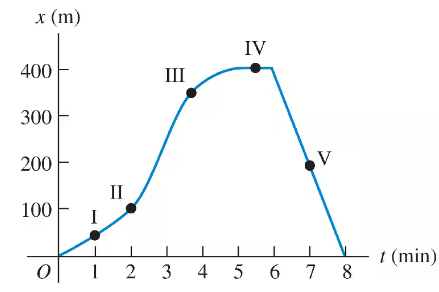
A physics professor leaves her house and walks along the sidewalk toward campus. After 55 min, it starts to rain, and she returns home. Her distance from her house as a function of time is shown in Fig. E2.102.10. At which of the labeled points is her velocity decreasing in magnitude?
Position-time graph showing a curve with labeled points I to V; velocity is zero at point IV.

Verified step by step guidance
1
To determine where the velocity is decreasing in magnitude, we need to analyze the slope of the distance-time graph at each labeled point.
Velocity is the derivative of the position with respect to time, which corresponds to the slope of the tangent to the curve at any point.
A decreasing magnitude of velocity means that the slope of the tangent line is becoming less steep, either positively or negatively.
Examine the graph: from point d to e, the slope of the graph is decreasing, indicating that the velocity is decreasing in magnitude.
Therefore, at point e, the velocity is decreasing in magnitude as the slope of the graph is less steep compared to the previous point d.

Verified video answer for a similar problem:

This video solution was recommended by our tutors as helpful for the problem above.
Video duration:
4m
Was this helpful?

Key Concepts

Here are the essential concepts you must grasp in order to answer the question correctly.

Velocity

Velocity is a vector quantity that describes the rate of change of position with respect to time, including both speed and direction. On a position-time graph, velocity is represented by the slope of the curve. A steeper slope indicates a higher velocity, while a flat slope indicates zero velocity.
Recommended video:
Guided course
7:27
Escape Velocity

Slope of a Graph

The slope of a graph at any point is the derivative of the function at that point, representing the rate of change. In a position-time graph, the slope indicates velocity. A decreasing slope means the velocity is decreasing, while an increasing slope means the velocity is increasing.
Recommended video:

Acceleration

Acceleration is the rate of change of velocity with respect to time. It can be positive (increasing velocity) or negative (decreasing velocity). On a position-time graph, acceleration is inferred from changes in the slope; a decreasing slope indicates negative acceleration, meaning the object is slowing down.
Recommended video:
Guided course
05:47
Intro to Acceleration
Related Practice
Textbook Question

A physics professor leaves her house and walks along the sidewalk toward campus. After 55 min, it starts to rain, and she returns home. Her distance from her house as a function of time is shown in Fig. E2.102.10. At which of the labeled points is her velocity constant and positive?

3
views
Textbook Question

A physics professor leaves her house and walks along the sidewalk toward campus. After 55 min, it starts to rain, and she returns home. Her distance from her house as a function of time is shown in Fig. E2.102.10. At which of the labeled points is her velocity zero?

2
views
Textbook Question

A physics professor leaves her house and walks along the sidewalk toward campus. After 55 min, it starts to rain, and she returns home. Her distance from her house as a function of time is shown in Fig. E2.102.10. At which of the labeled points is her velocity constant and negative?

3
views
Textbook Question

A turtle crawls along a straight line, which we will call the xx-axis with the positive direction to the right. The equation for the turtle's position as a function of time is x(t)=50.0x(t) = 50.0 cm + (2.002.00 cm/s)tt − (0.06250.0625 cm/s2)t2t^2. At what time tt is the velocity of the turtle zero?

1
views
Textbook Question

A turtle crawls along a straight line, which we will call the xx-axis with the positive direction to the right. The equation for the turtle's position as a function of time is x(t)=50.0x(t) = 50.0 cm + (2.002.00 cm/s)tt − (0.06250.0625 cm/s2)t2t^2. Sketch graphs of xx versus tt, vxv_{x} versus tt, and axa_{x} versus tt, for the time interval t=0t = 0 to t=40t = 40 s.

1
views
Textbook Question

A turtle crawls along a straight line, which we will call the xx-axis with the positive direction to the right. The equation for the turtle's position as a function of time is x(t)=50.0x(t) = 50.0 cm + (2.002.00 cm/s)tt − (0.06250.0625 cm/s2)t2t^2. Find the turtle's initial velocity, initial position, and initial acceleration.

2
views