Ch 02: Motion Along a Straight Line
Young & Freedman Calc - University Physics 15th Edition
Young & Freedman Calc15th EditionUniversity PhysicsISBN: 9780135159552Not the one you use?Change textbook
Chapter 2, Problem 7b

A car is stopped at a traffic light. It then travels along a straight road such that its distance from the light is given by x(t)=bt2ct3x(t)=bt^2-ct^3, where b=2.40b = 2.40 m/s2 and c=0.120c = 0.120 m/s3. Calculate the instantaneous velocity of the car at t=0t = 0, t=5.0t = 5.0 s, and t=10.0t = 10.0 s.

Verified step by step guidance
1
To find the instantaneous velocity of the car, we need to take the derivative of the position function x(t) with respect to time t. The position function given is x(t) = bt^2 − ct^3.
The derivative of x(t) with respect to t, which gives us the velocity function v(t), is v(t) = d(x(t))/dt = d(bt^2)/dt - d(ct^3)/dt.
Calculate the derivative of each term separately: The derivative of bt^2 with respect to t is 2bt, and the derivative of ct^3 with respect to t is 3ct^2.
Combine the derivatives to get the velocity function: v(t) = 2bt - 3ct^2.
Substitute the given values of b and c into the velocity function and evaluate it at the specified times t = 0, t = 5.0 s, and t = 10.0 s to find the instantaneous velocities at these times.

Verified video answer for a similar problem:

This video solution was recommended by our tutors as helpful for the problem above.
Video duration:
3m
Was this helpful?

Key Concepts

Here are the essential concepts you must grasp in order to answer the question correctly.

Instantaneous Velocity

Instantaneous velocity is the speed of an object at a specific moment in time. It is determined by taking the derivative of the position function with respect to time, which gives the rate of change of position. In this problem, the position function x(t) = bt² - ct³ needs to be differentiated to find the velocity function v(t).
Recommended video:
Guided course
06:28
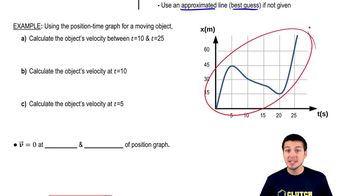
Position-Time Graphs and Instantaneous Velocity

Differentiation

Differentiation is a mathematical process used to find the rate at which a quantity changes. In physics, it is often used to calculate velocity from a position-time function. For the given function x(t) = bt² - ct³, differentiating with respect to time t gives v(t) = d(x)/dt = 2bt - 3ct², which is essential for finding instantaneous velocities.
Recommended video:
Guided course
13:04
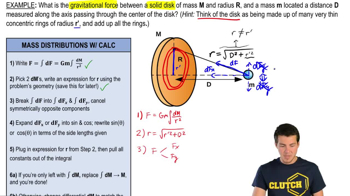
Gravitational Force from a Solid Disk

Position-Time Function

A position-time function describes how the position of an object changes over time. In this problem, x(t) = bt² - ct³ represents the car's position relative to the traffic light. Understanding this function is crucial for determining how the car's position evolves, which is necessary for calculating its velocity at specific times.
Recommended video:
Guided course
03:04
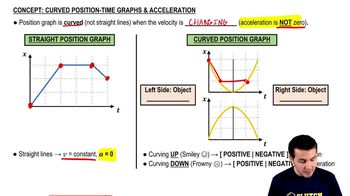
Curved Position-Time Graphs & Acceleration
Related Practice
Textbook Question

Starting from the front door of a ranch house, you walk 60.060.0 m due east to a windmill, turn around, and then slowly walk 40.040.0 m west to a bench, where you sit and watch the sunrise. It takes you 28.028.0 s to walk from the house to the windmill and then 36.036.0 s to walk from the windmill to the bench. For the entire trip from the front door to the bench, what are your (a) average velocity? (b) average speed?

5
views
Textbook Question

A physics professor leaves her house and walks along the sidewalk toward campus. After 55 min, it starts to rain, and she returns home. Her distance from her house as a function of time is shown in Fig. E2.102.10. At which of the labeled points is her velocity constant and positive?

3
views
Textbook Question

A physics professor leaves her house and walks along the sidewalk toward campus. After 55 min, it starts to rain, and she returns home. Her distance from her house as a function of time is shown in Fig. E2.102.10. At which of the labeled points is her velocity zero?

2
views
Textbook Question

You normally drive on the freeway between San Diego and Los Angeles at an average speed of 105105 km/h (6565 mi/h), and the trip takes 11 h and 5050 min. On a Friday afternoon, however, heavy traffic slows you down and you drive the same distance at an average speed of only 7070 km/h (4343 mi/h). How much longer does the trip take?

13
views
1
rank
Textbook Question

A physics professor leaves her house and walks along the sidewalk toward campus. After 55 min, it starts to rain, and she returns home. Her distance from her house as a function of time is shown in Fig. E2.102.10. At which of the labeled points is her velocity constant and negative?

3
views
Textbook Question

A car is stopped at a traffic light. It then travels along a straight road such that its distance from the light is given by x(t)=bt2ct3x(t)=bt^2-ct^3, where b=2.40b = 2.40 m/s2 and c=0.120c = 0.120 m/s3. Calculate the average velocity of the car for the time interval t=0t = 0 to t=10.0t = 10.0 s.

8
views