Two speakers that are 15.0 m apart produce in-phase sound waves of frequency 250.0 Hz in a room where the speed of sound is 340.0 m/s. A woman starts out at the midpoint between the two speakers. The room's walls and ceiling are covered with absorbers to eliminate reflections, and she listens with only one ear for best precision. What does she hear: constructive or destructive interference? Why?
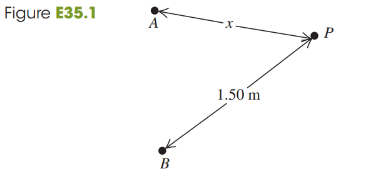
Two small stereo speakers A and B that are 1.40 m apart are sending out sound of wavelength 34 cm in all directions and all in phase. A person at point P starts out equidistant from both speakers and walks so that he is always 1.50 m from speaker B (Fig. E35.1). For what values of x will the sound this person hears be cancelled? Limit your solution to the cases where x ≤ 1.50 m.

Verified step by step guidance
Verified video answer for a similar problem:
Key Concepts
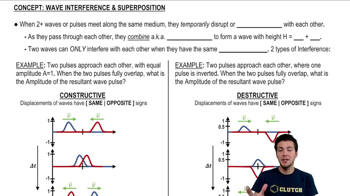
Wave Interference
Path Difference
Wavelength
Two small stereo speakers A and B that are 1.40 m apart are sending out sound of wavelength 34 cm in all directions and all in phase. A person at point P starts out equidistant from both speakers and walks so that he is always 1.50 m from speaker B (Fig. E35.1). For what values of x will the sound this person hears be maximally reinforced? Limit your solution to the cases where x ≤ 1.50 m.
Two speakers that are 15.0 m apart produce in-phase sound waves of frequency 250.0 Hz in a room where the speed of sound is 340.0 m/s. A woman starts out at the midpoint between the two speakers. The room's walls and ceiling are covered with absorbers to eliminate reflections, and she listens with only one ear for best precision. How far from the center must she walk before she first hears the sound maximally enhanced?
Two radio antennas A and B radiate in phase. Antenna B is 120 m to the right of antenna A. Consider point Q along the extension of the line connecting the antennas, a horizontal distance of 40 m to the right of antenna B. The frequency, and hence the wavelength, of the emitted waves can be varied. What is the longest wavelength for which there will be destructive interference at point Q?
