Ch 35: Interference
Young & Freedman Calc - University Physics 14th Edition
Young & Freedman Calc14th EditionUniversity PhysicsISBN: 9780321973610Not the one you use?Change textbook
Chapter 35, Problem 4a

Two radio antennas A and B radiate in phase. Antenna B is 120 m to the right of antenna A. Consider point Q along the extension of the line connecting the antennas, a horizontal distance of 40 m to the right of antenna B. The frequency, and hence the wavelength, of the emitted waves can be varied. What is the longest wavelength for which there will be destructive interference at point Q?

Verified step by step guidance
1
Identify the positions of the antennas and point Q on a coordinate line: let antenna A be at position 0 m, antenna B at 120 m, and point Q at 160 m (since it is 40 m to the right of B).
Calculate the distances from each antenna to point Q: the distance from A to Q is \(d_A = 160\) m, and from B to Q is \(d_B = 40\) m.
Determine the path difference \(\Delta d\) between the waves arriving at Q from antennas A and B: \(\Delta d = |d_A - d_B| = |160 - 40| = 120\) m.
Recall that for destructive interference between two in-phase sources, the path difference must satisfy the condition \(\Delta d = (m + \frac{1}{2}) \lambda\), where \(m\) is an integer (0, 1, 2, ...) and \(\lambda\) is the wavelength.
To find the longest wavelength causing destructive interference, set \(m = 0\) and solve for \(\lambda\): \(\lambda = 2 \Delta d\). This gives the fundamental wavelength for destructive interference at point Q.

Verified video answer for a similar problem:

This video solution was recommended by our tutors as helpful for the problem above.
Video duration:
8m
Was this helpful?

Key Concepts

Here are the essential concepts you must grasp in order to answer the question correctly.

Interference of Waves

Interference occurs when two or more waves overlap, resulting in a new wave pattern. Constructive interference happens when waves are in phase, amplifying the signal, while destructive interference occurs when waves are out of phase by half a wavelength, canceling each other out. Understanding interference is key to analyzing the combined effect of waves from antennas at a point.
Recommended video:
Guided course
03:47
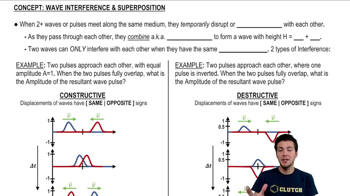
Wave Interference & Superposition

Path Difference and Phase Difference

The path difference is the difference in distance traveled by waves from two sources to a point. This difference determines the phase difference between the waves at that point. For destructive interference, the path difference must be an odd multiple of half wavelengths, causing the waves to arrive out of phase and cancel.
Recommended video:
Guided course
08:20
Mean Free Path

Relationship Between Wavelength, Frequency, and Speed

Wavelength (λ), frequency (f), and wave speed (v) are related by v = fλ. For electromagnetic waves like radio waves, the speed is constant (speed of light). Varying the frequency changes the wavelength, which affects interference patterns. Finding the longest wavelength for destructive interference involves using this relationship along with path difference conditions.
Recommended video:
Guided course
03:43
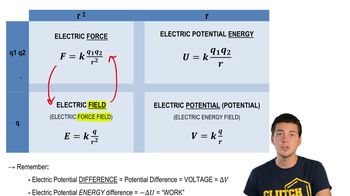
Relationships Between Force, Field, Energy, Potential
Related Practice
Textbook Question

Two speakers that are 15.0 m apart produce in-phase sound waves of frequency 250.0 Hz in a room where the speed of sound is 340.0 m/s. A woman starts out at the midpoint between the two speakers. The room's walls and ceiling are covered with absorbers to eliminate reflections, and she listens with only one ear for best precision. What does she hear: constructive or destructive interference? Why?

2
views
Textbook Question

Two small stereo speakers A and B that are 1.40 m apart are sending out sound of wavelength 34 cm in all directions and all in phase. A person at point P starts out equidistant from both speakers and walks so that he is always 1.50 m from speaker B (Fig. E35.1). For what values of x will the sound this person hears be cancelled? Limit your solution to the cases where x ≤ 1.50 m.

3
views
Textbook Question

Two speakers, emitting identical sound waves of wavelength 2.0 m in phase with each other, and an observer are located as shown in Fig. E35.5. At the observer's location, what is the path difference for waves from the two speakers?

2
views
Textbook Question

Coherent light with wavelength 450 nm falls on a pair of slits. On a screen 1.80 m away, the distance between dark fringes is 3.90 mm. What is the slit separation?

1
views
Textbook Question

Two speakers that are 15.0 m apart produce in-phase sound waves of frequency 250.0 Hz in a room where the speed of sound is 340.0 m/s. A woman starts out at the midpoint between the two speakers. The room's walls and ceiling are covered with absorbers to eliminate reflections, and she listens with only one ear for best precision. How far from the center must she walk before she first hears the sound maximally enhanced?

2
views
Textbook Question

Two radio antennas A and B radiate in phase. Antenna B is 120 m to the right of antenna A. Consider point Q along the extension of the line connecting the antennas, a horizontal distance of 40 m to the right of antenna B. The frequency, and hence the wavelength, of the emitted waves can be varied. What is the longest wavelength for which there will be constructive interference at point Q?

1
views