An L-R-C series circuit has L = 0.600 H and C = 3.00 mF. Calculate the angular frequency of oscillation for the circuit when R = 0.
Ch 30: Inductance
Young & Freedman Calc14th EditionUniversity PhysicsISBN: 9780321973610Not the one you use?Change textbook
Chapter 30, Problem 38b
An L-R-C series circuit has L = 0.600 H and C = 3.00 mF. What value of R gives critical damping?
Verified step by step guidance1
Understand that critical damping in an L-R-C circuit occurs when the damping is just enough to prevent oscillations. This happens when the damping coefficient is equal to the natural frequency of the system.
Recall the formula for the damping coefficient \( \gamma \) in an L-R-C circuit, which is given by \( \gamma = \frac{R}{2L} \).
The natural frequency \( \omega_0 \) of the circuit is given by \( \omega_0 = \frac{1}{\sqrt{LC}} \).
For critical damping, set the damping coefficient equal to the natural frequency: \( \frac{R}{2L} = \frac{1}{\sqrt{LC}} \).
Solve for \( R \) by rearranging the equation: \( R = 2L \times \frac{1}{\sqrt{LC}} \). Substitute the given values of \( L = 0.600 \) H and \( C = 3.00 \) mF to find the value of \( R \).

Verified video answer for a similar problem:
This video solution was recommended by our tutors as helpful for the problem above.
Video duration:
2mWas this helpful?
Key Concepts
Here are the essential concepts you must grasp in order to answer the question correctly.
Critical Damping
Critical damping occurs in a system when the damping is just enough to prevent oscillations. In an L-R-C circuit, it ensures the system returns to equilibrium as quickly as possible without oscillating. It is achieved when the damping coefficient equals the natural frequency of the system, leading to a smooth and rapid return to equilibrium.
Recommended video:
Guided course
Critical Angle
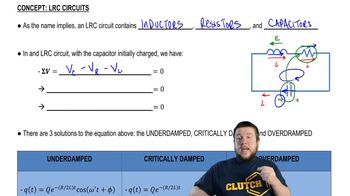
Damping in L-R-C Circuits
Damping in L-R-C circuits refers to the resistance that reduces the amplitude of oscillations over time. It is influenced by the resistor (R) in the circuit. The damping effect can be underdamped, critically damped, or overdamped, depending on the value of R relative to the inductance (L) and capacitance (C). Critical damping is the optimal condition for rapid stabilization.
Recommended video:
Guided course
LRC Circuits
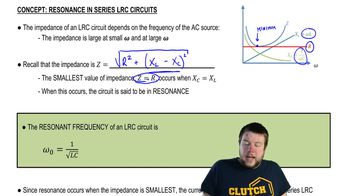
Resonance Frequency
The resonance frequency in an L-R-C circuit is the frequency at which the circuit naturally oscillates when not damped. It is determined by the inductance (L) and capacitance (C) and is given by the formula ω₀ = 1/√(LC). This frequency is crucial for calculating the damping conditions, including critical damping, as it relates to the system's natural response.
Recommended video:
Guided course
Resonance in Series LRC Circuits
Related Practice
Textbook Question
1
views
Textbook Question
An L-R-C series circuit has L = 0.450 H, C = 2.50 × 10⁻⁵ F, and resistance R. What is the angular frequency of the circuit when R = 0?
1
views
Textbook Question
An L-R-C series circuit has L = 0.450 H, C = 2.50 × 10⁻⁵ F, and resistance R. What value must R have to give a 5.0% decrease in angular frequency compared to the value calculated in part (a)?
1
views
Textbook Question
It has been proposed to use large inductors as energy storage devices. How much electrical energy is converted to light and thermal energy by a 150 W light bulb in one day?
8
views
Textbook Question
It has been proposed to use large inductors as energy storage devices. If the amount of energy calculated in part is stored in an inductor in which the current is 80.0 A, what is the inductance?
2
views