Ch 30: Inductance
Young & Freedman Calc - University Physics 14th Edition
Young & Freedman Calc14th EditionUniversity PhysicsISBN: 9780321973610Not the one you use?Change textbook
Chapter 30, Problem 39a

An L-R-C series circuit has L = 0.450 H, C = 2.50 × 10⁻⁵ F, and resistance R. What is the angular frequency of the circuit when R = 0?

Verified step by step guidance
1
Start by understanding the concept of an L-R-C series circuit, which consists of an inductor (L), a capacitor (C), and a resistor (R) connected in series. The angular frequency of such a circuit is determined by the inductance and capacitance when the resistance is zero.
Recall the formula for the angular frequency \( \omega \) of an L-R-C circuit when the resistance \( R = 0 \). The formula is given by \( \omega = \frac{1}{\sqrt{LC}} \). This formula is derived from the resonance condition of the circuit.
Substitute the given values into the formula. Here, \( L = 0.450 \) H and \( C = 2.50 \times 10^{-5} \) F. The substitution will look like \( \omega = \frac{1}{\sqrt{0.450 \times 2.50 \times 10^{-5}}} \).
Simplify the expression inside the square root. Calculate \( 0.450 \times 2.50 \times 10^{-5} \) to find the product of the inductance and capacitance.
Finally, take the square root of the product calculated in the previous step and then find the reciprocal to determine the angular frequency \( \omega \). This will give you the angular frequency of the circuit when \( R = 0 \).

Verified video answer for a similar problem:

This video solution was recommended by our tutors as helpful for the problem above.
Video duration:
1m
Was this helpful?

Key Concepts

Here are the essential concepts you must grasp in order to answer the question correctly.

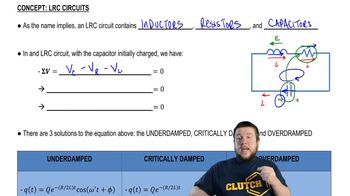
Angular Frequency in L-R-C Circuits

Angular frequency in an L-R-C circuit is a measure of how rapidly the circuit oscillates. When resistance R is zero, the circuit is purely oscillatory, and the angular frequency is determined by the inductance (L) and capacitance (C) using the formula ω = 1/√(LC). This frequency is crucial for understanding the natural oscillations of the circuit.
Recommended video:

Inductance

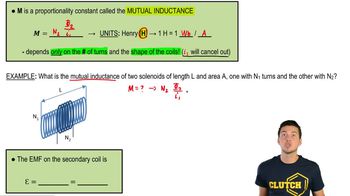
Inductance (L) is a property of a coil or inductor that quantifies its ability to store energy in a magnetic field when electrical current flows through it. In an L-R-C circuit, inductance affects the rate of change of current and plays a key role in determining the circuit's angular frequency, especially when resistance is negligible.
Recommended video:
Guided course
12:59
Mutual Induction

Capacitance

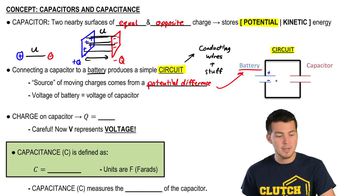
Capacitance (C) is the ability of a capacitor to store electrical energy in an electric field. It is a measure of how much charge a capacitor can hold per unit voltage. In an L-R-C circuit, capacitance influences the oscillation frequency, as it determines how quickly the circuit can charge and discharge, affecting the angular frequency when resistance is zero.
Recommended video:
Guided course
08:02
Capacitors & Capacitance (Intro)