
A capacitor is connected across an ac source that has voltage amplitude 60.0 V and frequency 80.0 Hz. What is the phase angle Φ for the source voltage relative to the current? Does the source voltage lag or lead the current?
Ch 31: Alternating Current
Young & Freedman Calc14th EditionUniversity PhysicsISBN: 9780321973610Not the one you use?Change textbook
Chapter 31, Problem 2a
A sinusoidal current i = I cosωt has an rms value Irms = 2.10 A. What is the current amplitude?
Verified step by step guidance1
Understand the relationship between the rms value and the amplitude of a sinusoidal current. The rms (root mean square) value is a measure of the effective value of a varying current, and for a sinusoidal current, it is related to the amplitude by the formula: I_rms = I_amplitude / sqrt(2).
Identify the given values in the problem. You are provided with the rms value of the current, I_rms = 2.10 A.
Use the formula to express the amplitude in terms of the rms value: I_amplitude = I_rms * sqrt(2).
Substitute the given rms value into the formula: I_amplitude = 2.10 A * sqrt(2).
Calculate the amplitude using the expression from the previous step. This will give you the current amplitude, which is the peak value of the sinusoidal current.

Verified video answer for a similar problem:
This video solution was recommended by our tutors as helpful for the problem above.
Video duration:
1mWas this helpful?
Key Concepts
Here are the essential concepts you must grasp in order to answer the question correctly.
RMS Value
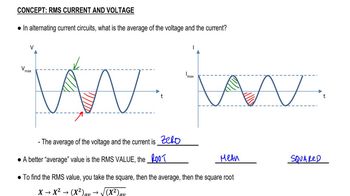
The root mean square (RMS) value of a sinusoidal current is a measure of the effective value of the alternating current. It is calculated as the square root of the average of the squares of the instantaneous values over one cycle. For a sinusoidal waveform, the RMS value is I_rms = I_0/√2, where I_0 is the amplitude.
Recommended video:
Guided course
RMS Current and Voltage
Current Amplitude
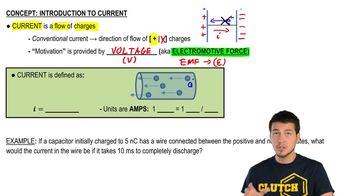
Current amplitude, denoted as I_0, is the peak value of the sinusoidal current. It represents the maximum instantaneous value that the current reaches during its cycle. In the context of RMS calculations, the amplitude is crucial for determining the effective current value using the relationship I_rms = I_0/√2.
Recommended video:
Guided course
Intro to Current
Sinusoidal Waveform
A sinusoidal waveform is a mathematical curve that describes a smooth periodic oscillation. It is characterized by its amplitude, frequency, and phase. In electrical circuits, sinusoidal currents and voltages are common, and their analysis involves understanding these parameters to determine effective values like RMS and peak amplitude.
Recommended video:
Guided course
Superposition of Sinusoidal Wave Functions
Related Practice
Textbook Question
1
views
Textbook Question
You have a special light bulb with a very delicate wire filament. The wire will break if the current in it ever exceeds 1.50 A, even for an instant. What is the largest root-mean-square current you can run through this bulb?
2
views
Textbook Question
A capacitor is connected across an ac source that has voltage amplitude 60.0 V and frequency 80.0 Hz. What is the capacitance C of the capacitor if the current amplitude is 5.30 A?
1
views
Textbook Question
The voltage across the terminals of an ac power supply varies with time according to Eq. (31.1) v = Vcosωt. The voltage amplitude is V = 45.0 V. What are (a) the root-mean-square potential difference Vrms and (b) the average potential difference Vav between the two terminals of the power supply?
1
views
