
Ch 31: Alternating Current
Young & Freedman Calc - University Physics 14th Edition
Young & Freedman Calc14th EditionUniversity PhysicsISBN: 9780321973610Not the one you use?Change textbook
Chapter 31, Problem 4a

A capacitor is connected across an ac source that has voltage amplitude 60.0 V and frequency 80.0 Hz. What is the phase angle Φ for the source voltage relative to the current? Does the source voltage lag or lead the current?

Verified step by step guidance
1
Understand the relationship between voltage and current in an AC circuit with a capacitor. In such a circuit, the current leads the voltage by a phase angle due to the capacitive reactance.
Recall the formula for the phase angle \( \Phi \) in a capacitive circuit, which is given by \( \Phi = -\frac{\pi}{2} \). This indicates that the voltage lags the current by 90 degrees.
Recognize that the negative sign in the phase angle formula indicates that the voltage lags behind the current.
Since the phase angle \( \Phi \) is \( -\frac{\pi}{2} \), the source voltage lags the current by 90 degrees.
Conclude that in a purely capacitive AC circuit, the phase angle is always \( -\frac{\pi}{2} \), meaning the voltage lags the current by 90 degrees.

Verified video answer for a similar problem:

This video solution was recommended by our tutors as helpful for the problem above.
Video duration:
3m
Was this helpful?

Key Concepts

Here are the essential concepts you must grasp in order to answer the question correctly.

Capacitive Reactance

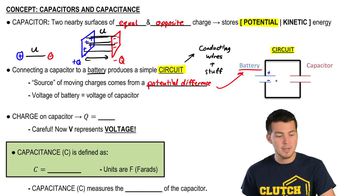
Capacitive reactance (Xc) is the opposition a capacitor offers to the flow of alternating current (AC). It is inversely proportional to the frequency (f) of the AC source and the capacitance (C) of the capacitor, given by the formula Xc = 1/(2πfC). This concept is crucial for understanding how the capacitor affects the phase relationship between voltage and current.
Recommended video:
Guided course
08:02
Capacitors & Capacitance (Intro)

Phase Angle in AC Circuits

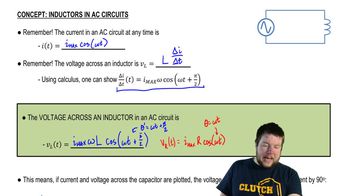
The phase angle (Φ) in AC circuits indicates the difference in phase between the voltage across and the current through a component. For a purely capacitive circuit, the current leads the voltage by 90 degrees, meaning the phase angle is -90 degrees. This concept helps determine whether the voltage leads or lags the current in the circuit.
Recommended video:
Guided course
07:14
Inductors in AC Circuits

Voltage and Current Relationship in Capacitors

In capacitors connected to an AC source, the current leads the voltage because the capacitor charges and discharges, causing the current to reach its peak before the voltage does. This relationship is essential for understanding the behavior of capacitors in AC circuits and determining the phase angle between voltage and current.
Recommended video:
Guided course
07:14
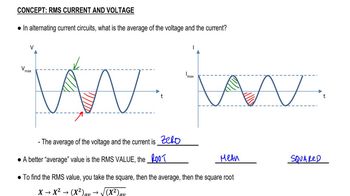
RMS Current and Voltage
Related Practice