Ch 27: Magnetic Field and Magnetic Forces
Young & Freedman Calc - University Physics 14th Edition
Young & Freedman Calc14th EditionUniversity PhysicsISBN: 9780321973610Not the one you use?Change textbook
Chapter 27, Problem 20

Cyclotrons are widely used in nuclear medicine for producing short-lived radioactive isotopes. These cyclotrons typically accelerate H- (the hydride ion, which has one proton and two electrons) to an energy of 5 MeV to 20 MeV. This ion has a mass very close to that of a proton because the electron mass is negligible — about 1/2000 of the proton's mass. A typical magnetic field in such cyclotrons is 1.9 T. (a) What is the speed of a 5.0 MeV H-? (b) If the H- has energy 5.0 MeV and B = 1.9 T, what is the radius of this ion's circular orbit?

Verified step by step guidance
1
To find the speed of the H- ion, we start by using the relationship between kinetic energy and speed. The kinetic energy (KE) of the ion is given as 5.0 MeV. First, convert this energy from MeV to joules using the conversion factor: 1 MeV = 1.60218 × 10^-13 J.
The kinetic energy formula is KE = (1/2)mv^2, where m is the mass of the ion and v is its speed. Since the mass of the H- ion is approximately the mass of a proton, use m ≈ 1.67 × 10^-27 kg. Rearrange the formula to solve for v: v = sqrt((2 * KE) / m).
Substitute the converted kinetic energy and the mass of the proton into the equation to find the speed v.
For part (b), to find the radius of the ion's circular orbit, use the formula for the radius of a charged particle moving in a magnetic field: r = (mv) / (qB), where m is the mass, v is the speed found in part (a), q is the charge of the H- ion (which is the charge of an electron, approximately -1.60218 × 10^-19 C), and B is the magnetic field strength, given as 1.9 T.
Substitute the values for m, v, q, and B into the formula to calculate the radius r of the ion's circular orbit.

Verified video answer for a similar problem:

This video solution was recommended by our tutors as helpful for the problem above.
Video duration:
5m
Was this helpful?

Key Concepts

Here are the essential concepts you must grasp in order to answer the question correctly.

Kinetic Energy and Speed Relationship

The kinetic energy of a particle is related to its speed through the equation KE = 0.5 * m * v^2, where KE is kinetic energy, m is mass, and v is speed. For high-energy particles like the H- ion, relativistic effects may need consideration, but at 5 MeV, classical mechanics can be used to approximate the speed by rearranging the formula to solve for v.
Recommended video:
Guided course
03:43
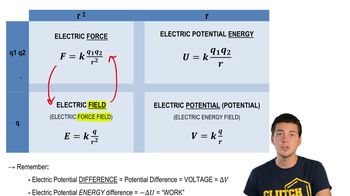
Relationships Between Force, Field, Energy, Potential

Cyclotron Motion and Magnetic Fields

Cyclotrons use magnetic fields to bend charged particles into circular paths. The radius of the orbit is determined by the balance between the magnetic force and the centripetal force, given by r = mv/qB, where m is mass, v is speed, q is charge, and B is the magnetic field strength. This relationship helps calculate the orbit radius of the H- ion in the cyclotron.
Recommended video:
Guided course
11:33
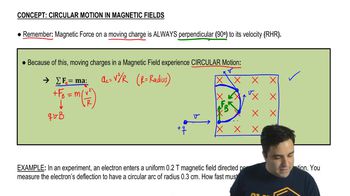
Circular Motion of Charges in Magnetic Fields

Energy Units and Conversion

Energy in physics is often expressed in electron volts (eV), where 1 eV is the energy gained by an electron when accelerated through a potential difference of 1 volt. For calculations involving kinetic energy, converting MeV to joules is necessary, using the conversion factor 1 MeV = 1.602 x 10^-13 joules, to apply classical mechanics equations effectively.
Recommended video:
Guided course
07:46
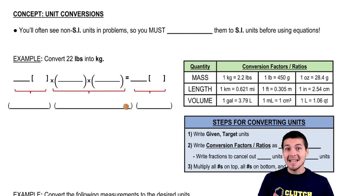
Unit Conversions
Related Practice
Textbook Question

In a cyclotron, the orbital radius of protons with energy 300 keV is 16.0 cm. You are redesigning the cyclotron to be used instead for alpha particles with energy 300 keV. An alpha particle has charge q = +2e and mass m = 6.64 x 10⁻²⁷ kg. If the magnetic field isn't changed, what will be the orbital radius of the alpha particles?

1
views
Textbook Question

An open plastic soda bottle with an opening diameter of 2.5 cm is placed on a table. A uniform 1.75 T magnetic field directed upward and oriented 25° from vertical encompasses the bottle. What is the total magnetic flux through the plastic of the soda bottle?

12
views
Textbook Question

A beam of protons traveling at 1.20 km/s enters a uniform magnetic field, traveling perpendicular to the field. The beam exits the magnetic field, leaving the field in a direction perpendicular to its original direction (Fig. E27.24) . The beam travels a distance of 1.18 cm while in the field. What is the magnitude of the magnetic field?

1
views
Textbook Question

A 150 g ball containing 4.00 x 10⁸ excess electrons is dropped into a 125 m vertical shaft. At the bottom of the shaft, the ball suddenly enters a uniform horizontal magnetic field that has magnitude 0.250 T and direction from east to west. If air resistance is negligibly small, find the magnitude and direction of the force that this magnetic field exerts on the ball just as it enters the field.

1
views
Textbook Question

A horizontal rectangular surface has dimensions 2.80 cm by 3.20 cm and is in a uniform magnetic field that is directed at an angle of 30.0° above the horizontal. What must the magnitude of the magnetic field be to produce a flux of 3.10 x 10⁻⁴ Wb through the surface?

Textbook Question

A deuteron (the nucleus of an isotope of hydrogen) has a mass of 3.34 x 10⁻²⁷ kg and a charge of +e. The deuteron travels in a circular path with a radius of 6.96 mm in a magnetic field with magnitude 2.50 T. (a) Find the speed of the deuteron. (b) Find the time required for it to make half a revolution. (c) Through what potential difference would the deuteron have to be accelerated to acquire this speed?

1
views