A straight, 2.5 m wire carries a typical household current of 1.5 A (in one direction) at a location where the earth's magnetic field is 0.55 gauss from south to north. Find the magnitude and direction of the force that our planet's magnetic field exerts on this wire if it is oriented so that the current in it is running (a) from west to east, (b) vertically upward, (c) from north to south. (d) Is the magnetic force ever large enough to cause significant effects under normal household conditions?
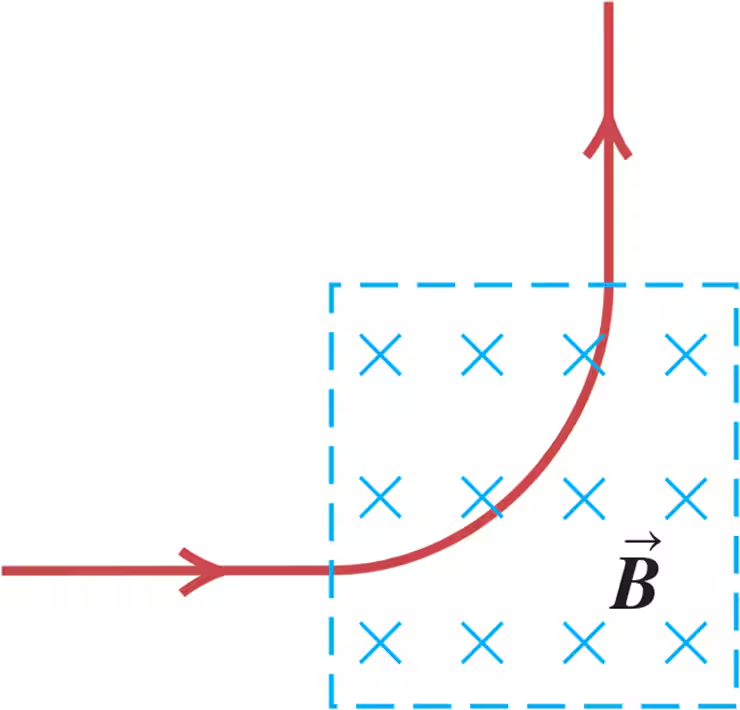
A beam of protons traveling at 1.20 km/s enters a uniform magnetic field, traveling perpendicular to the field. The beam exits the magnetic field, leaving the field in a direction perpendicular to its original direction (Fig. E27.24) . The beam travels a distance of 1.18 cm while in the field. What is the magnitude of the magnetic field?

Verified step by step guidance
Verified video answer for a similar problem:
Key Concepts
Lorentz Force
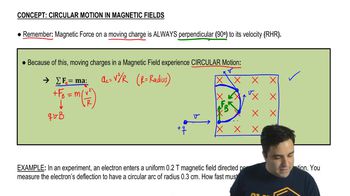
Circular Motion in Magnetic Fields
Magnetic Field and Path Deflection
In a cyclotron, the orbital radius of protons with energy 300 keV is 16.0 cm. You are redesigning the cyclotron to be used instead for alpha particles with energy 300 keV. An alpha particle has charge q = +2e and mass m = 6.64 x 10⁻²⁷ kg. If the magnetic field isn't changed, what will be the orbital radius of the alpha particles?
A 150 V battery is connected across two parallel metal plates of area 28.5 cm2 and separation 8.20 mm. A beam of alpha particles (charge +2e, mass 6.64 x 10⁻²⁷ kg) is accelerated from rest through a potential difference of 1.75 kV and enters the region between the plates perpendicular to the electric field, as shown in Fig. E27.29. What magnitude and direction of magnetic field are needed so that the alpha particles emerge undeflected from between the plates?
Cyclotrons are widely used in nuclear medicine for producing short-lived radioactive isotopes. These cyclotrons typically accelerate H- (the hydride ion, which has one proton and two electrons) to an energy of 5 MeV to 20 MeV. This ion has a mass very close to that of a proton because the electron mass is negligible — about 1/2000 of the proton's mass. A typical magnetic field in such cyclotrons is 1.9 T. (a) What is the speed of a 5.0 MeV H-? (b) If the H- has energy 5.0 MeV and B = 1.9 T, what is the radius of this ion's circular orbit?
Singly ionized (one electron removed) atoms are accelerated and then passed through a velocity selector consisting of perpendicular electric and magnetic fields. The electric field is 155 V/m and the magnetic field is 0.0315 T. The ions next enter a uniform magnetic field of magnitude 0.0175 T that is oriented perpendicular to their velocity. (a) How fast are the ions moving when they emerge from the velocity selector? (b) If the radius of the path of the ions in the second magnetic field is 17.5 cm, what is their mass?
A deuteron (the nucleus of an isotope of hydrogen) has a mass of 3.34 x 10⁻²⁷ kg and a charge of +e. The deuteron travels in a circular path with a radius of 6.96 mm in a magnetic field with magnitude 2.50 T. (a) Find the speed of the deuteron. (b) Find the time required for it to make half a revolution. (c) Through what potential difference would the deuteron have to be accelerated to acquire this speed?
