
Textbook Question
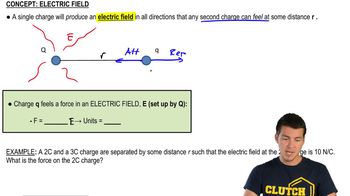
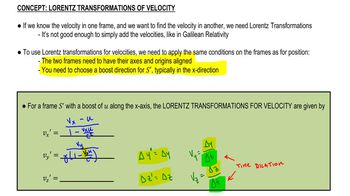
A proton is traveling horizontally to the right at m/s. How much time does it take the proton to stop after entering the field?

 Verified step by step guidance
 03:16
03:16
 13:39
13:39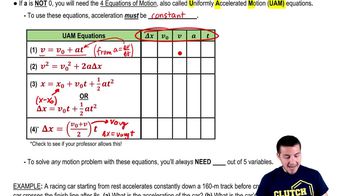 08:25
08:25A proton is traveling horizontally to the right at m/s. How much time does it take the proton to stop after entering the field?
A positive charge is fixed at the point , , and a negative charge is fixed at the point , . Show the positions of the charges in a diagram.
The earth has a net electric charge that causes a field at points near its surface equal to and directed in toward the center of the earth. What would be the force of repulsion between two people each with the charge calculated in part (a) and separated by a distance of m? Is use of the earth's electric field a feasible means of flight? Why or why not? Note: Part (a) asked for what magnitude and sign of charge would a -kg human have to acquire to overcome his or her weight by the force exerted by the earth's electric field.
Calculate the magnitude and direction (relative to the -axis) of the electric field in Example . Example : A point charge nC is located at the origin. Find the electric-field vector at the field point m, m.
A proton is traveling horizontally to the right at m/s. Find the magnitude and direction of the weakest electric field that can bring the proton uniformly to rest over a distance of cm.
The earth has a net electric charge that causes a field at points near its surface equal to and directed in toward the center of the earth. What magnitude and sign of charge would a -kg human have to acquire to overcome his or her weight by the force exerted by the earth's electric field?