Ch 21: Electric Charge and Electric Field
Young & Freedman Calc - University Physics 14th Edition
Young & Freedman Calc14th EditionUniversity PhysicsISBN: 9780321973610Not the one you use?Change textbook
Chapter 21, Problem 30a

Calculate the magnitude and direction (relative to the +x+x-axis) of the electric field in Example 21.621.6. Example 21.621.6: A point charge q=8.0q = -8.0 nC is located at the origin. Find the electric-field vector at the field point x=1.2x = 1.2 m, y=1.6y = -1.6 m.

Verified step by step guidance
1
Identify the position vector \( \mathbf{r} \) from the charge to the field point. The charge is at the origin, so \( \mathbf{r} = (1.2 \text{ m}) \hat{i} + (-1.6 \text{ m}) \hat{j} \).
Calculate the magnitude of the position vector \( r \) using the formula \( r = \sqrt{x^2 + y^2} \). Substitute \( x = 1.2 \text{ m} \) and \( y = -1.6 \text{ m} \) into the formula.
Use Coulomb's Law to find the magnitude of the electric field \( E \) at the point. The formula is \( E = \frac{k |q|}{r^2} \), where \( k \) is Coulomb's constant \( 8.99 \times 10^9 \text{ N m}^2/\text{C}^2 \) and \( q = -8.0 \text{ nC} \).
Determine the direction of the electric field vector. Since the charge is negative, the electric field points towards the charge. Calculate the angle \( \theta \) relative to the +x-axis using \( \theta = \tan^{-1}\left(\frac{y}{x}\right) \).
Express the electric field vector \( \mathbf{E} \) in component form using \( \mathbf{E} = E_x \hat{i} + E_y \hat{j} \), where \( E_x = E \cos(\theta) \) and \( E_y = E \sin(\theta) \).

Verified video answer for a similar problem:

This video solution was recommended by our tutors as helpful for the problem above.
Video duration:
7m
Was this helpful?

Key Concepts

Here are the essential concepts you must grasp in order to answer the question correctly.

Electric Field

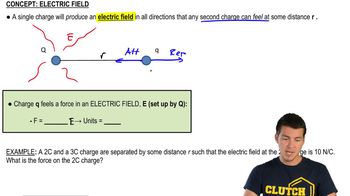
The electric field is a vector field around a charged particle that represents the force exerted per unit charge at any point in space. It is defined as E = F/q, where F is the force experienced by a small positive test charge q. The direction of the electric field is the direction of the force on a positive charge, and its magnitude is measured in newtons per coulomb (N/C).
Recommended video:
Guided course
03:16
Intro to Electric Fields

Coulomb's Law

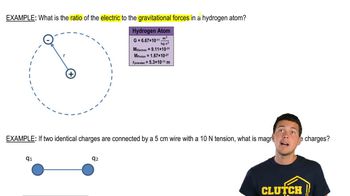
Coulomb's Law describes the force between two point charges. It states that the magnitude of the force F between two charges q1 and q2 is proportional to the product of the magnitudes of the charges and inversely proportional to the square of the distance r between them: F = k * |q1 * q2| / r^2, where k is Coulomb's constant. This law is essential for calculating the electric field due to a point charge.
Recommended video:
Guided course
09:52
Coulomb's Law

Vector Components

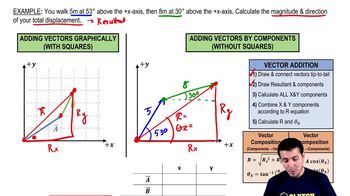
Vector components are the projections of a vector along the axes of a coordinate system. For a vector in two dimensions, such as the electric field, it can be broken down into x and y components using trigonometry: E_x = E * cos(θ) and E_y = E * sin(θ), where θ is the angle with respect to the +x-axis. Understanding vector components is crucial for determining the direction and magnitude of the electric field vector.
Recommended video:
Guided course
07:30
Vector Addition By Components
Related Practice
Textbook Question

A uniform electric field exists in the region between two oppositely charged plane parallel plates. A proton is released from rest at the surface of the positively charged plate and strikes the surface of the opposite plate, 1.601.60 cm distant from the first, in a time interval of 3.20×1063.20\(\times\)10^{-6} s. Find the magnitude of the electric field.

1
views
Textbook Question

A uniform electric field exists in the region between two oppositely charged plane parallel plates. A proton is released from rest at the surface of the positively charged plate and strikes the surface of the opposite plate, 1.601.60 cm distant from the first, in a time interval of 3.20×1063.20\(\times\)10^{-6} s. Find the speed of the proton when it strikes the negatively charged plate.

2
views
Textbook Question

The earth has a net electric charge that causes a field at points near its surface equal to 150150 N/CN/C and directed in toward the center of the earth. What would be the force of repulsion between two people each with the charge calculated in part (a) and separated by a distance of 100100 m? Is use of the earth's electric field a feasible means of flight? Why or why not? Note: Part (a) asked for what magnitude and sign of charge would a 6060-kg human have to acquire to overcome his or her weight by the force exerted by the earth's electric field.

1
views
Textbook Question

The earth has a net electric charge that causes a field at points near its surface equal to 150150 N/CN/C and directed in toward the center of the earth. What magnitude and sign of charge would a 6060-kg human have to acquire to overcome his or her weight by the force exerted by the earth's electric field?

Textbook Question

A proton is traveling horizontally to the right at 4.50×1064.50\(\times\)10^6 m/s. What minimum field (magnitude and direction) would be needed to stop an electron under the conditions of part (a)? Note: Part (a) asks for how much time does it take the proton to stop after entering the field.

1
views
Textbook Question

A +8.75+8.75-mC point charge is glued down on a horizontal frictionless table. It is tied to a 6.50-6.50-mC point charge by a light, nonconducting 2.502.50-cm wire. A uniform electric field of magnitude 1.85×1081.85\(\times\)10^8 N/CN/C is directed parallel to the wire, as shown in Fig. E21.3421.34. Find the tension in the wire.

1
views