Ch 25: Current, Resistance, and EMF
Young & Freedman Calc - University Physics 14th Edition
Young & Freedman Calc14th EditionUniversity PhysicsISBN: 9780321973610Not the one you use?Change textbook
Chapter 25, Problem 33b

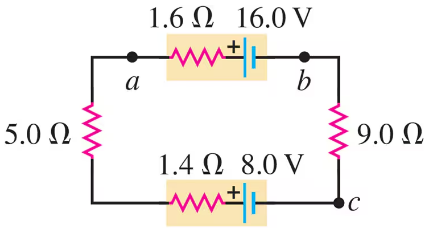
The circuit shown in Fig. E25.3325.33 contains two batteries, each with an emf and an internal resistance, and two resistors. Find the terminal voltage VabV_{ab} of the 16.016.0-V battery.
Circuit diagram with two batteries, internal resistances, and resistors: 1.6Ω, 16V; 1.4Ω, 8V; 5Ω; 9Ω.

Verified step by step guidance
1
Identify the components in the circuit: two batteries with emfs of 9.0 V and 4.0 V, internal resistances of 1.5 Ω and 1.0 Ω respectively, and two external resistors of 10.0 Ω and 5.5 Ω.
Apply Kirchhoff's loop rule to the circuit. Start at one point in the loop and move around the circuit, adding the emfs and subtracting the voltage drops across resistors. The sum should equal zero.
Express the voltage drop across each resistor using Ohm's Law, V = IR, where I is the current through the resistor and R is its resistance.
Set up the equation for the loop: 9.0 V - I(1.5 Ω) - I(10.0 Ω) - 4.0 V - I(1.0 Ω) - I(5.5 Ω) = 0. Solve this equation for the current I.
Calculate the terminal voltage Vab of the 9.0 V battery using the formula Vab = emf - Ir, where emf is the electromotive force of the battery and r is its internal resistance. Substitute the values to find Vab.

Verified video answer for a similar problem:

This video solution was recommended by our tutors as helpful for the problem above.
Video duration:
6m
Was this helpful?

Key Concepts

Here are the essential concepts you must grasp in order to answer the question correctly.

Kirchhoff's Loop Rule

Kirchhoff's Loop Rule states that the sum of the potential differences (voltage) around any closed loop in a circuit must equal zero. This principle is essential for analyzing circuits with multiple loops and components, as it allows us to set up equations that relate the emfs, resistances, and currents in the circuit. Applying this rule helps determine unknown values such as current or voltage across specific elements.
Recommended video:
11:15
Intro to Kirchhoff's Loop Rule

Terminal Voltage

Terminal voltage is the voltage output of a battery, measured across its terminals, and is affected by the internal resistance of the battery. It is calculated by subtracting the voltage drop due to the internal resistance from the emf of the battery. Understanding terminal voltage is crucial for determining the actual voltage available to the external circuit, which can differ from the battery's emf due to internal losses.
Recommended video:
Guided course
07:14
RMS Current and Voltage

Internal Resistance

Internal resistance is the inherent resistance within a battery that causes a voltage drop when current flows through it. This resistance affects the terminal voltage and efficiency of the battery. In circuit analysis, internal resistance is considered to calculate the actual voltage supplied to the circuit and the power dissipated within the battery itself, impacting the overall performance of the circuit.
Recommended video:
Guided course
04:54
Total Internal Energy