
Ch 25: Current, Resistance, and EMF
Young & Freedman Calc - University Physics 14th Edition
Young & Freedman Calc14th EditionUniversity PhysicsISBN: 9780321973610Not the one you use?Change textbook
Chapter 25, Problem 39b

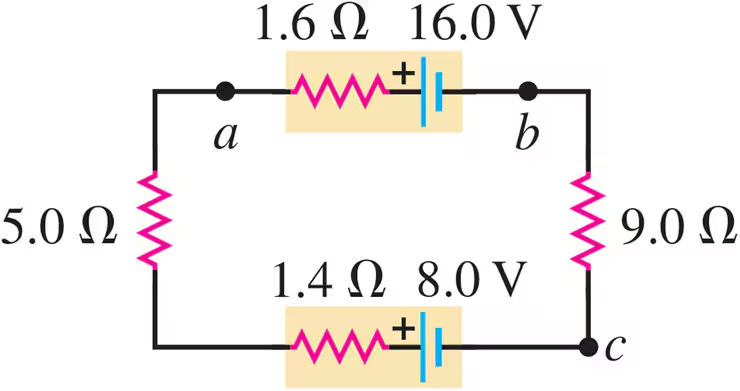
Consider the circuit of Fig. E25.30. What is the power output of the 16.0 V battery?

Verified step by step guidance
1
Identify the components in the circuit: The circuit consists of three batteries with voltages of 16.0 V, 13.5 V, and 7.5 V, and resistors with resistances of 2.2 Ω, 1.0 Ω, 8.0 Ω, and 6.0 Ω.
Apply Kirchhoff's loop rule: The sum of the potential differences (voltage) around any closed loop in a circuit must be zero. Write the equation for the loop considering the direction of current flow and the polarity of the batteries.
Calculate the total resistance in the circuit: Add up the resistances of the resistors in series to find the total resistance. The resistors are in series, so the total resistance R_total = 2.2 Ω + 1.0 Ω + 8.0 Ω + 6.0 Ω.
Determine the current in the circuit: Use Ohm's Law, V = IR, where V is the net voltage from the batteries, I is the current, and R is the total resistance. Solve for the current I.
Calculate the power output of the 16.0-V battery: Use the formula P = IV, where P is the power, I is the current calculated in the previous step, and V is the voltage of the 16.0-V battery.

Verified video answer for a similar problem:

This video solution was recommended by our tutors as helpful for the problem above.
Video duration:
7m
Was this helpful?

Key Concepts

Here are the essential concepts you must grasp in order to answer the question correctly.

Ohm's Law

Ohm's Law is fundamental in circuit analysis, stating that the current (I) through a conductor between two points is directly proportional to the voltage (V) across the two points and inversely proportional to the resistance (R) of the conductor. It is expressed as V = IR, and is essential for calculating current in the circuit, which is needed to determine the power output of the battery.
Recommended video:
Guided course
03:07
Resistance and Ohm's Law

Power in Electrical Circuits

Power in electrical circuits is the rate at which energy is transferred or converted. It is calculated using the formula P = VI, where P is power, V is voltage, and I is current. Understanding this concept is crucial for determining the power output of the battery, as it involves calculating the product of the battery's voltage and the current flowing through the circuit.
Recommended video:
Guided course
06:18
Power in Circuits

Kirchhoff's Voltage Law

Kirchhoff's Voltage Law states that the sum of the electrical potential differences (voltage) around any closed network is zero. This principle is used to analyze the circuit by ensuring that the sum of the voltages provided by the batteries equals the sum of the voltage drops across the resistors, allowing for the calculation of current and subsequently the power output of the battery.
Recommended video:
Guided course
04:08
Kirchhoff's Junction Rule
Related Practice
Textbook Question

When a resistor with resistance RR is connected to a 1.501.50-V flashlight battery, the resistor consumes 0.06250.0625 W of electrical power. (Throughout, assume that each battery has negligible internal resistance.) What power does the resistor consume if it is connected to a 12.612.6-V car battery? Assume that RR remains constant when the power consumption changes.

1
views
Textbook Question

The circuit shown in Fig. E25.3325.33 contains two batteries, each with an emf and an internal resistance, and two resistors. Find the terminal voltage VabV_{ab} of the 16.016.0-V battery.

21
views
Textbook Question

Consider the circuit of Fig. E25.30 Show that the power output of the 16.0 V battery equals the overall rate of consumption of electrical energy in the rest of the circuit.

1
views
Textbook Question

Consider the circuit of Fig. E25.30. What is the total rate at which electrical energy is dissipated in the 5.0 Ω and 9.0 Ω resistors?

1
views
Textbook Question

Consider the circuit of Fig. E25.30. At what rate is electrical energy being converted to other forms in the 8.0 V battery?

1
views
Textbook Question

Electric eels generate electric pulses along their skin that can be used to stun an enemy when they come into contact with it. Tests have shown that these pulses can be up to 500 V and produce currents of 80 mA (or even larger). A typical pulse lasts for 10 ms. What power and how much energy are delivered to the unfortunate enemy with a single pulse, assuming a steady current?