Two moles of an ideal gas are heated at constant pressure from °C to °C. Calculate the work done by the gas.
Ch 19: The First Law of Thermodynamics
Young & Freedman Calc14th EditionUniversity PhysicsISBN: 9780321973610Not the one you use?Change textbook
Chapter 19, Problem 1a
Two moles of an ideal gas are heated at constant pressure from °C to °C. Draw a -diagram for this process.
Verified step by step guidance1
Step 1: Understand the process described. The problem involves heating an ideal gas at constant pressure, which means the process is isobaric. In an isobaric process, the pressure remains constant while the volume changes as the temperature changes.
Step 2: Convert the given temperatures from Celsius to Kelvin, as thermodynamic calculations typically use the Kelvin scale. Use the formula: T(K) = T(°C) + 273.15. So, convert 27°C and 107°C to Kelvin.
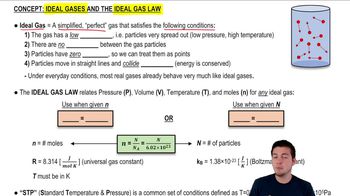
Step 3: Use the ideal gas law to understand the relationship between pressure, volume, and temperature. The ideal gas law is given by: , where p is pressure, V is volume, n is the number of moles, R is the ideal gas constant, and T is temperature in Kelvin.
Step 4: Since the process is isobaric, the pressure p is constant. Therefore, the relationship between volume and temperature can be expressed as: , where V and T are the initial volume and temperature, and V' and T' are the final volume and temperature.
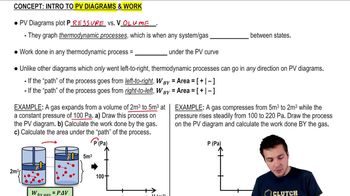
Step 5: To draw the pV-diagram, plot the initial and final states on a graph with pressure (p) on the y-axis and volume (V) on the x-axis. Since the pressure is constant, the line connecting the initial and final states will be horizontal, indicating an increase in volume as the temperature increases.

Verified video answer for a similar problem:
This video solution was recommended by our tutors as helpful for the problem above.
Video duration:
2mWas this helpful?
Key Concepts
Here are the essential concepts you must grasp in order to answer the question correctly.
Ideal Gas Law
The Ideal Gas Law is a fundamental equation in thermodynamics, expressed as PV = nRT, where P is pressure, V is volume, n is the number of moles, R is the universal gas constant, and T is temperature in Kelvin. It describes the relationship between these variables for an ideal gas, allowing us to predict how changes in one variable affect the others.
Recommended video:
Guided course
Ideal Gases and the Ideal Gas Law
Constant Pressure Process
In a constant pressure process, the pressure of the gas remains unchanged while other variables, such as volume and temperature, may vary. For an ideal gas, as temperature increases at constant pressure, the volume must also increase according to the Ideal Gas Law, resulting in a linear relationship on a pV-diagram.
Recommended video:
Guided course
Phase Constant of a Wave Function
pV-Diagram
A pV-diagram is a graphical representation of the relationship between pressure (p) and volume (V) for a given thermodynamic process. For a constant pressure process, the diagram will show a horizontal line, indicating that pressure remains constant while volume changes. This visualization helps in understanding the behavior of gases during different thermodynamic processes.
Recommended video:
Guided course
Work and PV Diagrams
Related Practice
Textbook Question
1
views
Textbook Question
The graph in Fig. E shows a -diagram of the air in a human lung when a person is inhaling and then exhaling a deep breath. Such graphs, obtained in clinical practice, are normally somewhat curved, but we have modeled one as a set of straight lines of the same general shape. (Important: The pressure shown is the gauge pressure, not the absolute pressure.) How many joules of net work does this person's lung do during one complete breath?
Textbook Question
Six moles of an ideal gas are in a cylinder fitted at one end with a movable piston. The initial temperature of the gas is °C and the pressure is constant. As part of a machine design project, calculate the final temperature of the gas after it has done J of work.