
The graph in Fig. E shows a -diagram of the air in a human lung when a person is inhaling and then exhaling a deep breath. Such graphs, obtained in clinical practice, are normally somewhat curved, but we have modeled one as a set of straight lines of the same general shape. (Important: The pressure shown is the gauge pressure, not the absolute pressure.) The process illustrated here is somewhat different from those we have been studying, because the pressure change is due to changes in the amount of gas in the lung, not to temperature changes. (Think of your own breathing. Your lungs do not expand because they've gotten hot.) If the temperature of the air in the lung remains a reasonable °C, what is the maximum number of moles in this person's lung during a breath?

- Ch 01: Units, Physical Quantities & Vectors41
- Ch 02: Motion Along a Straight Line67
- Ch 03: Motion in Two or Three Dimensions47
- Ch 04: Newton's Laws of Motion23
- Ch 05: Applying Newton's Laws59
- Ch 06: Work & Kinetic Energy14
- Ch 07: Potential Energy & Conservation8
- Ch 08: Momentum, Impulse, and Collisions18
- Ch 09: Rotation of Rigid Bodies42
- Ch 10: Dynamics of Rotational Motion48
- Ch 11: Equilibrium & Elasticity27
- Ch 12: Fluid Mechanics31
- Ch 13: Gravitation35
- Ch 14: Periodic Motion32
- Ch 15: Mechanical Waves25
- Ch 16: Sound & Hearing32
- Ch 17: Temperature and Heat36
- Ch 18: Thermal Properties of Matter38
- Ch 19: The First Law of Thermodynamics33
- Ch 20: The Second Law of Thermodynamics22
- Ch 21: Electric Charge and Electric Field36
- Ch 22: Gauss' Law24
- Ch 23: Electric Potential31
- Ch 24: Capacitance and Dielectrics18
- Ch 25: Current, Resistance, and EMF26
- Ch 26: Direct-Current Circuits30
- Ch 27: Magnetic Field and Magnetic Forces18
- Ch 28: Sources of Magnetic Field10
- Ch 29: Electromagnetic Induction28
- Ch 30: Inductance17
- Ch 31: Alternating Current21
- Ch 32: Electromagnetic Waves1
- Ch 33: The Nature and Propagation of Light20
- Ch 34: Geometric Optics34
- Ch 35: Interference19
- Ch 36: Diffraction25
- Ch 37: Special Relativity20
- Ch 38: Photons: Light Waves Behaving as Particles15
- Ch 39: Particles Behaving as Waves26
- Ch 40: Quantum Mechanics I: Wave Functions21
- Ch 41: Quantum Mechanics II: Atomic Structure25
- Ch 42: Molecules and Condensed Matter18
- Ch 43: Nuclear Physics16
- Ch 44: Particle Physics and Cosmology23
Two moles of an ideal gas are heated at constant pressure from °C to °C. Calculate the work done by the gas.
 Verified step by step guidance
Verified video answer for a similar problem:

Key Concepts
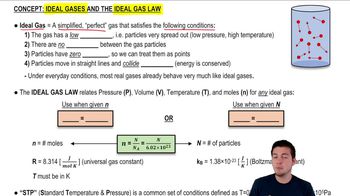
Ideal Gas Law
 07:21
07:21
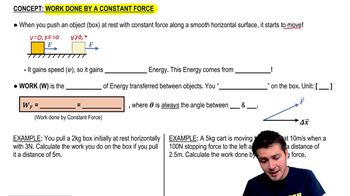
Work Done by a Gas at Constant Pressure
 06:09
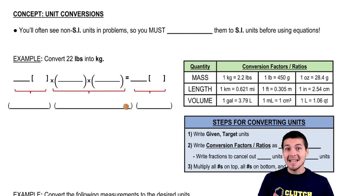
06:09Temperature Conversion
 07:46
07:46Two moles of an ideal gas are heated at constant pressure from °C to °C. Draw a -diagram for this process.
The graph in Fig. E shows a -diagram of the air in a human lung when a person is inhaling and then exhaling a deep breath. Such graphs, obtained in clinical practice, are normally somewhat curved, but we have modeled one as a set of straight lines of the same general shape. (Important: The pressure shown is the gauge pressure, not the absolute pressure.) How many joules of net work does this person's lung do during one complete breath?
Six moles of an ideal gas are in a cylinder fitted at one end with a movable piston. The initial temperature of the gas is °C and the pressure is constant. As part of a machine design project, calculate the final temperature of the gas after it has done J of work.