
Ch 18: Thermal Properties of Matter
Young & Freedman Calc - University Physics 14th Edition
Young & Freedman Calc14th EditionUniversity PhysicsISBN: 9780321973610Not the one you use?Change textbook
Chapter 18, Problem 26a

Consider an ideal gas at 2727°C and 1.001.00 atm. To get some idea how close these molecules are to each other, on the average, imagine them to be uniformly spaced, with each molecule at the center of a small cube. What is the length of an edge of each cube if adjacent cubes touch but do not overlap?

Verified step by step guidance
1
Convert the temperature from Celsius to Kelvin. The formula for conversion is: T=27+273.15. This gives the temperature in Kelvin, which is necessary for calculations involving gases.
Use the ideal gas law to find the volume occupied by one mole of gas. The ideal gas law is given by: PV=nRT, where P is the pressure, V is the volume, n is the number of moles, R is the ideal gas constant, and T is the temperature in Kelvin.
Calculate the volume occupied by one mole of gas at 1 atm and the converted temperature using the ideal gas law. Rearrange the formula to solve for V: V=nRTP. Use R = 0.0821 L·atm/mol·K.
Determine the volume occupied by a single molecule. Since one mole of gas contains Avogadro's number of molecules, divide the volume of one mole by Avogadro's number (6.022×10^23 molecules/mol) to find the volume occupied by one molecule.
Calculate the length of an edge of the cube. Since the volume of the cube is equal to the volume occupied by one molecule, use the formula for the volume of a cube: V=a3, where a is the length of an edge. Solve for a by taking the cube root of the volume occupied by one molecule.

Verified video answer for a similar problem:

This video solution was recommended by our tutors as helpful for the problem above.
Video duration:
4m
Was this helpful?

Key Concepts

Here are the essential concepts you must grasp in order to answer the question correctly.

Ideal Gas Law

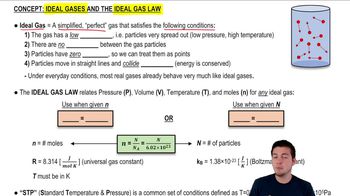
The Ideal Gas Law, PV = nRT, relates the pressure (P), volume (V), and temperature (T) of an ideal gas to the number of moles (n) and the gas constant (R). It is crucial for calculating the volume occupied by the gas molecules, which helps in determining the average spacing between them.
Recommended video:
Guided course
07:21
Ideal Gases and the Ideal Gas Law

Molecular Volume

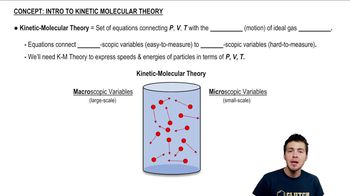
Molecular volume refers to the space occupied by a single molecule in a given volume of gas. By assuming each molecule is at the center of a cube, the volume of the cube can be calculated using the total volume of the gas divided by the number of molecules, providing insight into the average distance between molecules.
Recommended video:
Guided course
01:50
Introduction to Kinetic-Molecular Theory

Avogadro's Number

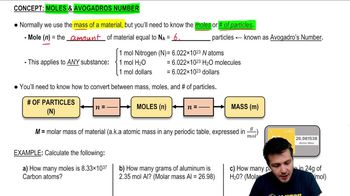
Avogadro's Number (approximately 6.022 x 10^23) is the number of molecules in one mole of a substance. It is essential for converting moles of gas into the number of molecules, which is necessary to calculate the volume of each cube surrounding a molecule in the gas.
Recommended video:
Guided course
07:19
Moles & Avogadro's Number
Related Practice