Ch 18: Thermal Properties of Matter
Young & Freedman Calc - University Physics 14th Edition
Young & Freedman Calc14th EditionUniversity PhysicsISBN: 9780321973610Not the one you use?Change textbook
Chapter 18, Problem 27a

What is the total translational kinetic energy of the air in an empty room that has dimensions 8.008.00 m×12.00\(\times\)12.00 m×4.00\(\times\)4.00 m if the air is treated as an ideal gas at 1.001.00 atm?

Verified step by step guidance
1
Calculate the volume of the room using the formula for the volume of a rectangular prism: \( V = \text{length} \times \text{width} \times \text{height} \). Substitute the given dimensions: \( V = 8.00 \text{ m} \times 12.00 \text{ m} \times 4.00 \text{ m} \).
Use the ideal gas law to find the number of moles of air in the room. The ideal gas law is \( PV = nRT \), where \( P \) is the pressure, \( V \) is the volume, \( n \) is the number of moles, \( R \) is the ideal gas constant, and \( T \) is the temperature. Assume standard temperature (e.g., 298 K) and use \( R = 8.314 \text{ J/mol K} \). Rearrange to solve for \( n \): \( n = \frac{PV}{RT} \).
Determine the translational kinetic energy of the gas using the formula \( KE = \frac{3}{2} nRT \). This formula comes from the kinetic theory of gases, which states that the translational kinetic energy of an ideal gas is proportional to the number of moles and the temperature.
Substitute the values for \( n \), \( R \), and \( T \) into the kinetic energy formula to find the total translational kinetic energy of the air in the room.
Ensure all units are consistent, particularly checking that pressure is in pascals (1 atm = 101325 Pa) and volume is in cubic meters, to maintain consistency in the calculations.

Verified video answer for a similar problem:

This video solution was recommended by our tutors as helpful for the problem above.
Video duration:
1m
Was this helpful?

Key Concepts

Here are the essential concepts you must grasp in order to answer the question correctly.

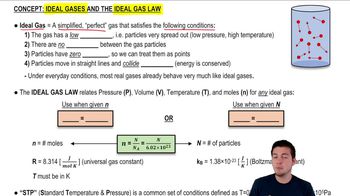
Ideal Gas Law

The Ideal Gas Law is a fundamental equation in thermodynamics that relates the pressure, volume, and temperature of an ideal gas. It is expressed as PV = nRT, where P is pressure, V is volume, n is the number of moles, R is the universal gas constant, and T is temperature. This law helps determine the amount of gas in a given space, crucial for calculating kinetic energy.
Recommended video:
Guided course
07:21
Ideal Gases and the Ideal Gas Law

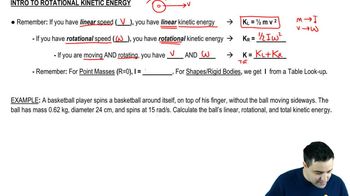
Translational Kinetic Energy

Translational kinetic energy refers to the energy possessed by an object due to its motion through space. For a gas, it is calculated using the formula KE = (3/2) nRT, where n is the number of moles and T is the temperature. This concept is essential for understanding how the motion of gas molecules contributes to the total energy in a system.
Recommended video:
Guided course
06:07
Intro to Rotational Kinetic Energy

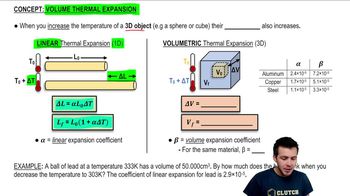
Volume Calculation

Volume calculation is crucial for determining the amount of space occupied by a gas, which directly affects its pressure and kinetic energy. In this context, the volume of the room is calculated by multiplying its dimensions: 8.00 m * 12.00 m * 4.00 m, resulting in 384 cubic meters. This volume is used in conjunction with the Ideal Gas Law to find the number of moles of air in the room.
Recommended video:
Guided course
05:21
Volume Thermal Expansion
Related Practice
Textbook Question

A flask contains a mixture of neon (Ne), krypton (Kr), and radon (Rn) gases. Compare the root-mean-square speeds. (Hint: Appendix D shows the molar mass (in g/mol) of each element under the chemical symbol for that element.)

20
views
Textbook Question

A flask contains a mixture of neon (Ne), krypton (Kr), and radon (Rn) gases. Compare the average kinetic energies of the three types of atoms.

1
views
Textbook Question

Consider an ideal gas at 2727°C and 1.001.00 atm. To get some idea how close these molecules are to each other, on the average, imagine them to be uniformly spaced, with each molecule at the center of a small cube. What is the length of an edge of each cube if adjacent cubes touch but do not overlap?

1
views
Textbook Question

We have two equal-size boxes, A and B. Each box contains gas that behaves as an ideal gas. We insert a thermometer into each box and find that the gas in box A is at 5050°C while the gas in box B is at 1010°C. This is all we know about the gas in the boxes. Which of the following statements must be true? Which could be true? Explain your reasoning.

(a) The pressure in A is higher than in B.

(b) There are more molecules in A than in B.

(c) A and B do not contain the same type of gas.

(d) The molecules in A have more average kinetic energy per molecule than those in B.

(e) The molecules in A are moving faster than those in B.
1
views
Textbook Question

Modern vacuum pumps make it easy to attain pressures of the order of 101310^{-13} atm in the laboratory. Consider a volume of air and treat the air as an ideal gas. How many molecules would be present at the same temperature but at 1.001.00 atm instead?

2
views
Textbook Question

In a gas at standard conditions, what is the length of the side of a cube that contains a number of molecules equal to the population of the earth (about 7×1097\(\times\)10^9 people)?