
Ch 17: Temperature and Heat
Young & Freedman Calc - University Physics 14th Edition
Young & Freedman Calc14th EditionUniversity PhysicsISBN: 9780321973610Not the one you use?Change textbook
Chapter 17, Problem 57a

Suppose that the rod in Fig. 17.2417.24a is made of copper, is 45.045.0 cm long, and has a cross-sectional area of 1.251.25 cm2 . Let TH=100.0TH = 100.0°C and TC=0.0TC = 0.0°C. What is the final steady-state temperature gradient along the rod?
Illustration of heat transfer in a copper rod with temperatures TH and TC.

Verified step by step guidance
1
Identify the formula for the heat current (H) through a rod, which is given by Fourier's law of heat conduction: H = k * A * (dT/dx), where k is the thermal conductivity, A is the cross-sectional area, and dT/dx is the temperature gradient.
Recognize that in a steady-state condition, the heat current is constant along the rod, and the temperature gradient (dT/dx) can be expressed as (TH - TC) / L, where TH and TC are the temperatures at the hot and cold ends, respectively, and L is the length of the rod.
Substitute the given values into the expression for the temperature gradient: TH = 100.0°C, TC = 0.0°C, and L = 45.0 cm. Convert the length to meters for consistency in units: L = 0.45 m.
The cross-sectional area A is given as 1.25 cm². Convert this to m²: A = 1.25 * 10^-4 m².
Use the known thermal conductivity of copper (k ≈ 385 W/m·K) to calculate the temperature gradient: dT/dx = (TH - TC) / L. This will give you the final steady-state temperature gradient along the rod.

Verified video answer for a similar problem:

This video solution was recommended by our tutors as helpful for the problem above.
Video duration:
1m
Was this helpful?

Key Concepts

Here are the essential concepts you must grasp in order to answer the question correctly.

Heat Transfer

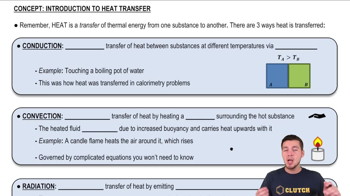
Heat transfer is the process by which thermal energy moves from a region of higher temperature to a region of lower temperature. In the context of the rod, heat flows from the hot end (TH) to the cold end (TC) through conduction, which is the transfer of heat through a material without the movement of the material itself.
Recommended video:
Guided course
05:14
Overview of Heat Transfer

Thermal Conductivity

Thermal conductivity is a material property that indicates how well a substance can conduct heat. For copper, which has a high thermal conductivity, this means it can efficiently transfer heat along its length. The rate of heat transfer through the rod is directly proportional to the temperature difference and the cross-sectional area, and inversely proportional to the length of the rod.
Recommended video:
Guided course
05:21
Volume Thermal Expansion

Temperature Gradient

The temperature gradient is the rate of temperature change with respect to distance in a material. In the case of the copper rod, the temperature gradient can be calculated by dividing the temperature difference (TH - TC) by the length of the rod (L). This gradient is crucial for determining how heat flows through the rod and reaches a steady state.
Recommended video:
Guided course
04:54
Introduction To Temperature Scales
Related Practice
Textbook Question

An electric kitchen range has a total wall area of 1.401.40 m2 and is insulated with a layer of fiberglass 4.004.00 cm thick. The inside surface of the fiberglass has a temperature of 175175°C, and its outside surface is at 35.035.0°C. The fiberglass has a thermal conductivity of 0.040W/mK0.040\;W/m\(\cdot\) K. What is the heat current through the insulation, assuming it may be treated as a flat slab with an area of 1.401.40 m2 ?

1
views
Textbook Question

A carpenter builds an exterior house wall with a layer of wood 3.03.0 cm thick on the outside and a layer of Styrofoam insulation 2.22.2 cm thick on the inside wall surface. The wood has k=0.080W/mKk=0.080\,W/m\(\cdot\) K , and the Styrofoam has k=0.027W/mKk=0.027\,W/m\(\cdot\) K. The interior surface temperature is 19.019.0°C, and the exterior surface temperature is 10.0-10.0°C. What is the temperature at the plane where the wood meets the Styrofoam?

2
views
Textbook Question

A vessel whose walls are thermally insulated contains 2.402.40 kg of water and 0.4500.450 kg of ice, all at 0.00.0°C. The outlet of a tube leading from a boiler in which water is boiling at atmospheric pressure is inserted into the water. How many grams of steam must condense inside the vessel (also at atmospheric pressure) to raise the temperature of the system to 28.028.0°C? You can ignore the heat transferred to the container.

1
views
Textbook Question

A carpenter builds an exterior house wall with a layer of wood 3.03.0 cm thick on the outside and a layer of Styrofoam insulation 2.22.2 cm thick on the inside wall surface. The wood has k=0.080W/mKk=0.080\,W/m\(\cdot\) K , and the Styrofoam has k=0.027W/mKk=0.027\,W/m\(\cdot\) K. The interior surface temperature is 19.019.0°C, and the exterior surface temperature is 10.0-10.0°C. What is the rate of heat flow per square meter through this wall?

2
views
Textbook Question

A 4.004.00-kg silver ingot is taken from a furnace, where its temperature is 750.0750.0°C, and placed on a large block of ice at 0.00.0°C. Assuming that all the heat given up by the silver is used to melt the ice, how much ice is melted?

3
views
Textbook Question

Two rods, one made of brass and the other made of copper, are joined end to end. The length of the brass section is 0.300 0.300 m and the length of the copper section is 0.8000.800 m. Each segment has cross-sectional area 0.005000.00500 m2. The free end of the brass segment is in boiling water and the free end of the copper segment is in an ice–water mixture, in both cases under normal atmospheric pressure. The sides of the rods are insulated so there is no heat loss to the surroundings. What mass of ice is melted in 5.005.00 min by the heat conducted by the composite rod?

1
views