
Ch 17: Temperature and Heat
Young & Freedman Calc - University Physics 14th Edition
Young & Freedman Calc14th EditionUniversity PhysicsISBN: 9780321973610Not the one you use?Change textbook
Chapter 17, Problem 60a

An electric kitchen range has a total wall area of 1.401.40 m2 and is insulated with a layer of fiberglass 4.004.00 cm thick. The inside surface of the fiberglass has a temperature of 175175°C, and its outside surface is at 35.035.0°C. The fiberglass has a thermal conductivity of 0.040W/mK0.040\;W/m\(\cdot\) K. What is the heat current through the insulation, assuming it may be treated as a flat slab with an area of 1.401.40 m2 ?

Verified step by step guidance
1
Identify the formula for heat current through a flat slab, which is given by Fourier's law of heat conduction: \( Q = \frac{k \cdot A \cdot (T_{inside} - T_{outside})}{d} \), where \( Q \) is the heat current, \( k \) is the thermal conductivity, \( A \) is the area, \( T_{inside} \) and \( T_{outside} \) are the temperatures of the inside and outside surfaces, and \( d \) is the thickness of the slab.
Substitute the given values into the formula: \( k = 0.040 \text{ W/m K} \), \( A = 1.40 \text{ m}^2 \), \( T_{inside} = 175°C \), \( T_{outside} = 35.0°C \), and \( d = 0.04 \text{ m} \).
Calculate the temperature difference \( \Delta T = T_{inside} - T_{outside} = 175°C - 35°C \).
Plug the values into the formula: \( Q = \frac{0.040 \cdot 1.40 \cdot (175 - 35)}{0.04} \).
Simplify the expression to find the heat current \( Q \). This will give you the rate at which heat is transferred through the fiberglass insulation.

Verified video answer for a similar problem:

This video solution was recommended by our tutors as helpful for the problem above.
Video duration:
2m
Was this helpful?

Key Concepts

Here are the essential concepts you must grasp in order to answer the question correctly.

Thermal Conductivity

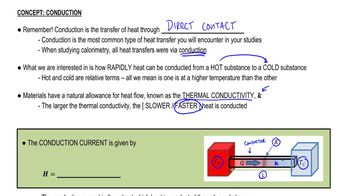
Thermal conductivity is a material property that indicates how well a material can conduct heat. It is defined as the amount of heat that passes through a material with a given thickness, area, and temperature difference. In this problem, the fiberglass's thermal conductivity is crucial for calculating the heat current through the insulation.
Recommended video:

Heat Current

Heat current, also known as heat flow rate, is the rate at which heat energy transfers through a material. It is calculated using the formula Q = kA(T1 - T2)/d, where k is the thermal conductivity, A is the area, T1 and T2 are the temperatures on either side of the material, and d is the thickness. Understanding this concept is essential for solving the problem of heat transfer through the fiberglass.
Recommended video:
Guided course
05:38
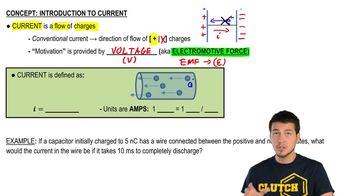
Intro to Current

Temperature Gradient

The temperature gradient is the change in temperature across a material per unit distance. It is a driving factor for heat transfer, as heat flows from regions of higher temperature to lower temperature. In this scenario, the temperature difference between the inside and outside surfaces of the fiberglass creates a gradient that influences the heat current calculation.
Recommended video:
Guided course
04:54
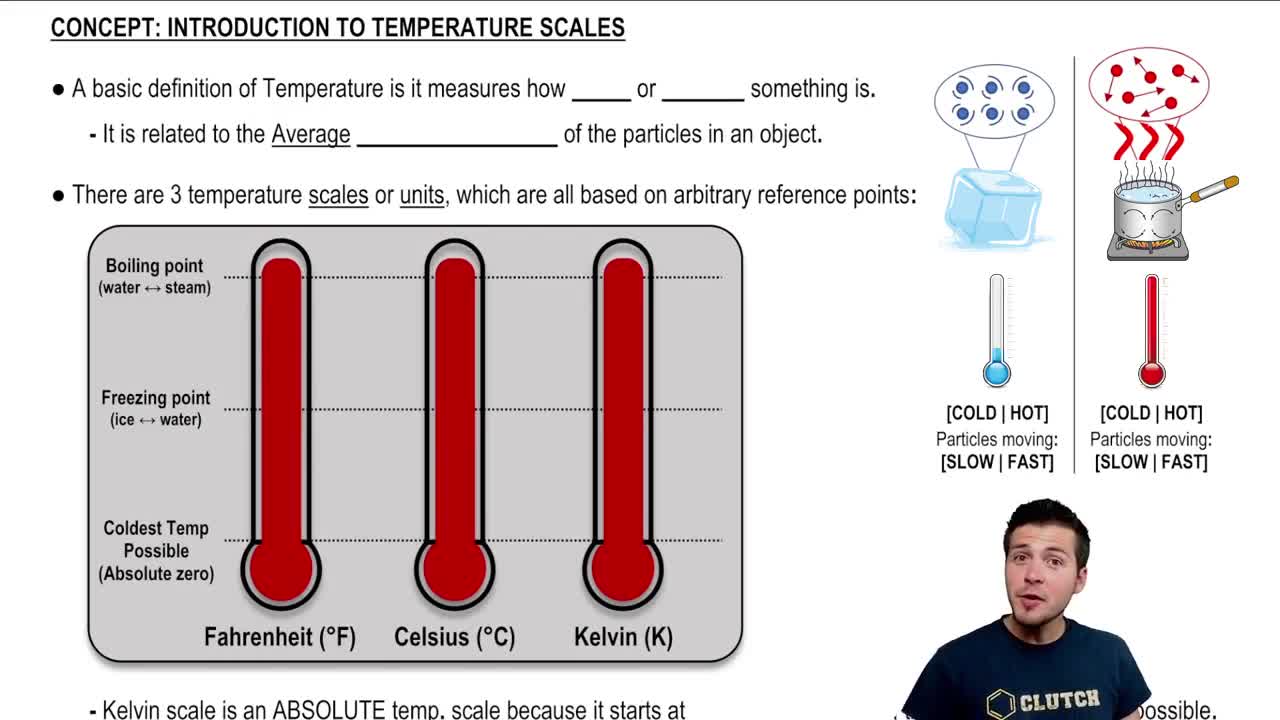
Introduction To Temperature Scales
Related Practice
Textbook Question

The blood plays an important role in removing heat from the body by bringing this energy directly to the surface where it can radiate away. Nevertheless, this heat must still travel through the skin before it can radiate away. Assume that the blood is brought to the bottom layer of skin at 37.037.0°C and that the outer surface of the skin is at 30.030.0°C. Skin varies in thickness from 0.500.50 mm to a few millimeters on the palms and soles, so assume an average thickness of 0.750.75 mm. A 165165-lb, 66-ft-tall person has a surface area of about 2.02.0 m2 and loses heat at a net rate of 7575 W while resting. On the basis of our assumptions, what is the thermal conductivity of this person's skin?

2
views
Textbook Question

Suppose that the rod in Fig. 17.2417.24a is made of copper, is 45.045.0 cm long, and has a cross-sectional area of 1.251.25 cm2 . Let TH=100.0TH = 100.0°C and TC=0.0TC = 0.0°C. What is the final steady-state temperature gradient along the rod?

1
views
Textbook Question

The emissivity of tungsten is 0.3500.350. A tungsten sphere with radius 1.501.50 cm is suspended within a large evacuated enclosure whose walls are at 290.0290.0 K. What power input is required to maintain the sphere at 3000.03000.0 K if heat conduction along the supports is ignored?

2
views
Textbook Question

A carpenter builds an exterior house wall with a layer of wood 3.03.0 cm thick on the outside and a layer of Styrofoam insulation 2.22.2 cm thick on the inside wall surface. The wood has k=0.080W/mKk=0.080\,W/m\(\cdot\) K , and the Styrofoam has k=0.027W/mKk=0.027\,W/m\(\cdot\) K. The interior surface temperature is 19.019.0°C, and the exterior surface temperature is 10.0-10.0°C. What is the temperature at the plane where the wood meets the Styrofoam?

2
views
Textbook Question

A carpenter builds an exterior house wall with a layer of wood 3.03.0 cm thick on the outside and a layer of Styrofoam insulation 2.22.2 cm thick on the inside wall surface. The wood has k=0.080W/mKk=0.080\,W/m\(\cdot\) K , and the Styrofoam has k=0.027W/mKk=0.027\,W/m\(\cdot\) K. The interior surface temperature is 19.019.0°C, and the exterior surface temperature is 10.0-10.0°C. What is the rate of heat flow per square meter through this wall?

2
views
Textbook Question

A spherical pot contains 0.750.75 L of hot coffee (essentially water) at an initial temperature of 9595°C. The pot has an emissivity of 0.600.60, and the surroundings are at 20.0 20.0°C. Calculate the coffee's rate of heat loss by radiation.

2
views