
Ch 16: Sound & Hearing
Young & Freedman Calc - University Physics 14th Edition
Young & Freedman Calc14th EditionUniversity PhysicsISBN: 9780321973610Not the one you use?Change textbook
Chapter 16, Problem 15

You are trying to overhear a juicy conversation, but from your distance of 15.0 m, it sounds like only an average whisper of 20.0 dB. How close should you move to the chatterboxes for the sound level to be 60.0 dB?

Verified step by step guidance
1
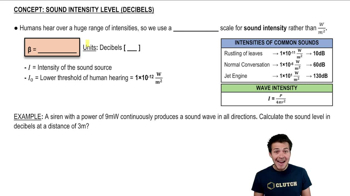
Understand that sound intensity level in decibels (dB) is a logarithmic measure of the intensity of a sound relative to a reference level. The formula to convert intensity to decibels is: L=10log(IIref), where I is the intensity of the sound and Iref is the reference intensity.
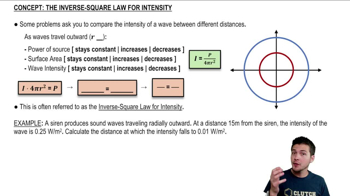
Recognize that the intensity of sound decreases with distance according to the inverse square law: IPr2, where P is the power of the sound source and r is the distance from the source.
Set up the equation for the initial condition at 15.0 m with a sound level of 20.0 dB: 20=10log(IIref). Solve for I.
Set up the equation for the desired condition at a new distance r with a sound level of 60.0 dB: 60=10log(IIref). Solve for I.
Use the inverse square law to relate the two intensities and distances: IIref=r2r2. Solve for the new distance r.

Verified video answer for a similar problem:

This video solution was recommended by our tutors as helpful for the problem above.
Video duration:
4m
Was this helpful?

Key Concepts

Here are the essential concepts you must grasp in order to answer the question correctly.

Decibel Scale

The decibel (dB) scale is a logarithmic unit used to measure sound intensity. It quantifies sound levels relative to a reference level, typically the threshold of hearing. A change of 10 dB represents a tenfold change in intensity, making it crucial for understanding how sound levels increase or decrease with distance.
Recommended video:
Guided course
04:25
Sound Intensity Level and the Decibel Scale

Inverse Square Law

The inverse square law states that the intensity of sound decreases with the square of the distance from the source. This principle is essential for calculating how sound intensity changes as you move closer or farther from the source, helping to determine the necessary distance to achieve a desired sound level.
Recommended video:
Guided course
05:26
The Inverse-Square Law for Intensity

Sound Intensity and Distance

Sound intensity is the power per unit area carried by a sound wave. As you move closer to a sound source, the intensity increases, and the perceived loudness rises. Understanding the relationship between sound intensity and distance is key to solving problems involving changes in sound levels due to movement.
Recommended video:
Guided course
04:25
Sound Intensity Level and the Decibel Scale