
Textbook Question
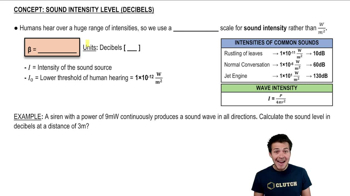
You are trying to overhear a juicy conversation, but from your distance of 15.0 m, it sounds like only an average whisper of 20.0 dB. How close should you move to the chatterboxes for the sound level to be 60.0 dB?
 Verified step by step guidance
 04:25
04:25
 04:05
04:05 05:17
05:17You are trying to overhear a juicy conversation, but from your distance of 15.0 m, it sounds like only an average whisper of 20.0 dB. How close should you move to the chatterboxes for the sound level to be 60.0 dB?
(a) By what factor must the sound intensity be increased to raise the sound intensity level by 13.0 dB? (b) Explain why you don't need to know the original sound intensity
An oscillator vibrating at 1250 Hz produces a sound wave that travels through an ideal gas at 325 m/s when the gas temperature is 22.0°C. For a certain experiment, you need to have the same oscillator produce sound of wavelength 28.5 cm in this gas. What should the gas temperature be to achieve this wavelength?
A sound wave in air at 20°C has a frequency of 320 Hz and a displacement amplitude of 5.00 × 10⁻³ mm. For this sound wave calculate the pressure amplitude (in Pa)
A metal bar with a length of 1.50 m has density 6400 kg/m3. Longitudinal sound waves take 3.90 × 10⁻⁴ s to travel from one end of the bar to the other. What is Young's modulus for this metal?
What must be the stress (F/A) in a stretched wire of a material whose Young's modulus is Y for the speed of longitudinal waves to equal 30 times the speed of transverse waves?