
Ch 15: Mechanical Waves
Young & Freedman Calc - University Physics 14th Edition
Young & Freedman Calc14th EditionUniversity PhysicsISBN: 9780321973610Not the one you use?Change textbook
Chapter 15, Problem 34a

Two pulses are moving in opposite directions at 1.0 cm/s on a taut string, as shown in Fig. E15.34. Each square is 1.0 cm.
<Image>
Sketch the shape of the string at the end of 6.0 s.

Verified step by step guidance
1
Identify the initial positions of the two pulses on the string. The left pulse is moving to the right, and the right pulse is moving to the left.
Determine the speed of each pulse. Both pulses are moving at 1.0 cm/s.
Calculate the distance each pulse will travel in 6.0 seconds. Since the speed is 1.0 cm/s, each pulse will travel 6.0 cm in 6.0 seconds.
Sketch the new positions of the pulses after 6.0 seconds. The left pulse will have moved 6.0 cm to the right, and the right pulse will have moved 6.0 cm to the left.
Consider the interaction of the pulses if they overlap. Since the pulses are moving towards each other, check if they overlap after 6.0 seconds and sketch the resulting shape of the string, taking into account the principle of superposition.

Verified video answer for a similar problem:

This video solution was recommended by our tutors as helpful for the problem above.
Video duration:
4m
Was this helpful?

Key Concepts

Here are the essential concepts you must grasp in order to answer the question correctly.

Wave Propagation

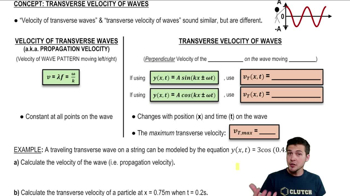
Wave propagation refers to the movement of waves through a medium. In this scenario, the pulses are traveling along a taut string at a constant speed of 1.0 cm/s. Understanding wave propagation is crucial to predict the future position of the pulses after a given time, such as 6 seconds in this problem.
Recommended video:
Guided course
07:32
Transverse Velocity of Waves

Superposition Principle

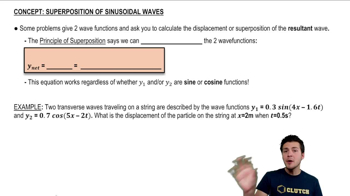
The superposition principle states that when two or more waves overlap, the resultant displacement at any point is the sum of the displacements due to each wave. This principle is essential for sketching the string's shape when the two pulses meet, as their combined effect will determine the string's configuration at that moment.
Recommended video:
Guided course
03:32
Superposition of Sinusoidal Wave Functions

Reflection and Transmission of Waves

While not directly involved in this problem, understanding reflection and transmission can help anticipate how waves behave at boundaries. In this case, the pulses are moving towards each other, and knowing how they interact upon meeting (e.g., whether they pass through each other or reflect) is important for predicting the string's shape after 6 seconds.
Recommended video:
Guided course
06:25
Law of Reflection
Related Practice
Textbook Question

A fellow student with a mathematical bent tells you that the wave function of a traveling wave on a thin rope is y(x,t)=(2.30mm)cos[(16.98 rad/m)x+(742 rad/s)t]y(x,t)=\(\left\)(2.30\(\operatorname{mm)}\]\cos\)[\(\left\)(16.98\(\text{ }\)rad/m\(\right\))x+(742\(\text{ }\)rad/s\(\right\))t]. Being more practical, you measure the rope to have a length of 1.35 m1.35\(\text{ m}\) and a mass of 0.00338kg0.00338\(\operatorname{kg}\). You are then asked to determine the following: (f) tension in the rope; (g) average power transmitted by the wave.

1
views
Textbook Question

A fellow student with a mathematical bent tells you that the wave function of a traveling wave on a thin rope is y(x,t)=(2.30mm)cos[(16.98 rad/m)x+(742 rad/s)t]y(x,t)=\(\left\)(2.30\(\operatorname{mm)}\]\cos\)[\(\left\)(16.98\(\text{ }\)rad/m\(\right\))x+(742\(\text{ }\)rad/s\(\right\))t]. Being more practical, you measure the rope to have a length of 1.35 m1.35\(\text{ m}\) and a mass of 0.00338kg0.00338\(\operatorname{kg}\). You are then asked to determine the following: (d) wave speed; (e) direction the wave is traveling;

1
views
Textbook Question

At a distance of 7.00 x 10¹² m from a star, the intensity of the radiation from the star is 15.4 W/m2. Assuming that the star radiates uniformly in all directions, what is the total power output of the star?

1
views
Textbook Question

A 1.50-m-long rope is stretched between two supports with a tension that makes the speed of transverse waves 62.0 m/s.What are the wavelength and frequency of the second overtone?

1
views
Textbook Question

Two pulses are moving in opposite directions at 1.0 cm/s on a taut string, as shown in Fig. E15.34. Each square is 1.0 cm. <IMAGE> Sketch the shape of the string at the end of 7.0 s.

2
views
Textbook Question

A 1.50-m-long rope is stretched between two supports with a tension that makes the speed of transverse waves 62.0 m/s.What are the wavelength and frequency of the fundamental?

1
views