
Textbook Question
Two pulses are moving in opposite directions at 1.0 cm/s on a taut string, as shown in Fig. E15.34. Each square is 1.0 cm.
<Image>
Sketch the shape of the string at the end of 6.0 s.
1
views

 Verified step by step guidance
 08:30
08:30
 06:34
06:34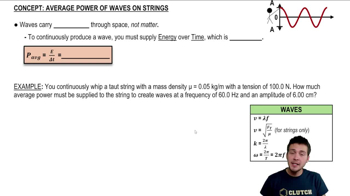 04:39
04:39Two pulses are moving in opposite directions at 1.0 cm/s on a taut string, as shown in Fig. E15.34. Each square is 1.0 cm.
<Image>
Sketch the shape of the string at the end of 6.0 s.
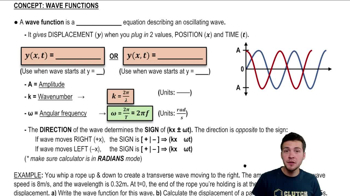
A fellow student with a mathematical bent tells you that the wave function of a traveling wave on a thin rope is . Being more practical, you measure the rope to have a length of and a mass of . You are then asked to determine the following: (d) wave speed; (e) direction the wave is traveling;
At a distance of 7.00 x 10¹² m from a star, the intensity of the radiation from the star is 15.4 W/m2. Assuming that the star radiates uniformly in all directions, what is the total power output of the star?
A fellow student with a mathematical bent tells you that the wave function of a traveling wave on a thin rope is . Being more practical, you measure the rope to have a length of and a mass of . You are then asked to determine the following: (a) amplitude; (b) frequency; (c) wavelength.
Two pulses are moving in opposite directions at 1.0 cm/s on a taut string, as shown in Fig. E15.34. Each square is 1.0 cm. <IMAGE> Sketch the shape of the string at the end of 7.0 s.
Energy Output. By measurement you determine that sound waves are spreading out equally in all directions from a point source and that the intensity is 0.026 W/m2 at a distance of 4.3 m from the source. How much sound energy does the source emit in one hour if its power output remains constant?