
Ch 15: Mechanical Waves
Young & Freedman Calc - University Physics 14th Edition
Young & Freedman Calc14th EditionUniversity PhysicsISBN: 9780321973610Not the one you use?Change textbook
Chapter 15, Problem 26

Threshold of Pain. You are investigating the report of a UFO landing in an isolated portion of New Mexico, and you encounter a strange object that is radiating sound waves uniformly in all directions. Assume that the sound comes from a point source and that you can ignore reflections. You are slowly walking toward the source. When you are 7.5 m from it, you measure its intensity to be 0.11 W/m2. An intensity of 1.0 W/m2 is often used as the 'threshold of pain.' How much closer to the source can you move before the sound intensity reaches this threshold?

Verified step by step guidance
1
Understand that sound intensity is defined as the power per unit area, and it decreases with distance from the source according to the inverse square law. This means that the intensity is proportional to 1/r^2, where r is the distance from the source.
Use the formula for sound intensity from a point source: I = P / (4πr^2), where I is the intensity, P is the power of the source, and r is the distance from the source. You are given I = 0.11 W/m^2 at r = 7.5 m.
Calculate the power of the source using the given intensity and distance: P = I * 4πr^2. Substitute I = 0.11 W/m^2 and r = 7.5 m into the equation to find P.
Set up the equation for the threshold of pain intensity, I_threshold = 1.0 W/m^2, using the same formula: I_threshold = P / (4πr_threshold^2). Substitute the calculated power P and solve for r_threshold.
Determine how much closer you can move by calculating the difference between the initial distance (7.5 m) and the new distance (r_threshold) where the intensity reaches the threshold of pain.

Verified video answer for a similar problem:

This video solution was recommended by our tutors as helpful for the problem above.
Video duration:
3m
Was this helpful?

Key Concepts

Here are the essential concepts you must grasp in order to answer the question correctly.

Sound Intensity

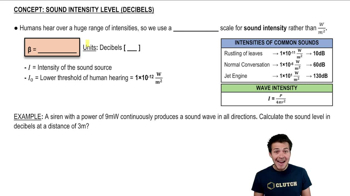
Sound intensity is the power per unit area carried by a sound wave, measured in watts per square meter (W/m^2). It quantifies the energy transmitted by the wave and is crucial for understanding how loud a sound is perceived. In this problem, the intensity changes as you move closer to the sound source, affecting the perceived loudness.
Recommended video:
Guided course
04:25
Sound Intensity Level and the Decibel Scale

Inverse Square Law

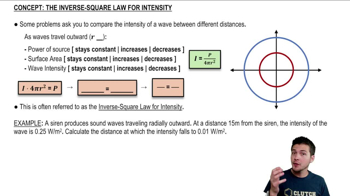
The inverse square law states that the intensity of a sound wave from a point source decreases with the square of the distance from the source. Mathematically, intensity is inversely proportional to the square of the distance (I ∝ 1/r^2). This principle helps determine how the intensity changes as you move closer to or farther from the source.
Recommended video:
Guided course
05:26
The Inverse-Square Law for Intensity

Threshold of Pain

The threshold of pain is the sound intensity level at which sound becomes physically painful to hear, typically around 1.0 W/m^2. Understanding this threshold is essential for determining how close you can approach the sound source before the intensity becomes unbearable, guiding the calculation of the maximum permissible distance.
Recommended video:
Guided course
08:11
Static Friction & Equilibrium
Related Practice
Textbook Question

A jet plane at takeoff can produce sound of intensity 10.0 W/m2 at 30.0 m away. But you prefer the tranquil sound of normal conversation, which is 1.0 μW/m2. Assume that the plane behaves like a point source of sound. (a) What is the closest dis-tance you should live from the airport runway to preserve your peace of mind? (b) What intensity from the jet does your friend experience if she lives twice as far from the runway as you do? (c) What power of sound does the jet produce at takeoff?

1
views
Textbook Question

A fellow student with a mathematical bent tells you that the wave function of a traveling wave on a thin rope is y(x,t)=(2.30mm)cos[(16.98 rad/m)x+(742 rad/s)t]y(x,t)=\(\left\)(2.30\(\operatorname{mm)}\]\cos\)[\(\left\)(16.98\(\text{ }\)rad/m\(\right\))x+(742\(\text{ }\)rad/s\(\right\))t]. Being more practical, you measure the rope to have a length of 1.35 m1.35\(\text{ m}\) and a mass of 0.00338kg0.00338\(\operatorname{kg}\). You are then asked to determine the following: (a) amplitude; (b) frequency; (c) wavelength.

1
views
Textbook Question

The speed of sound in air at 20°C is 344 m/s. (a) What is the wavelength of a sound wave with a frequency of 784 Hz, corresponding to the note G5 on a piano, and how many milliseconds does each vibration take? (b) What is the wavelength of a sound wave one octave higher (twice the frequency) than the note in part (a)?

2
views
Textbook Question

Energy Output. By measurement you determine that sound waves are spreading out equally in all directions from a point source and that the intensity is 0.026 W/m2 at a distance of 4.3 m from the source. What is the intensity at a distance of 3.1 m from the source?

2
views
Textbook Question

Energy Output. By measurement you determine that sound waves are spreading out equally in all directions from a point source and that the intensity is 0.026 W/m2 at a distance of 4.3 m from the source. How much sound energy does the source emit in one hour if its power output remains constant?

3
views