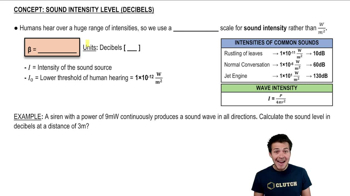
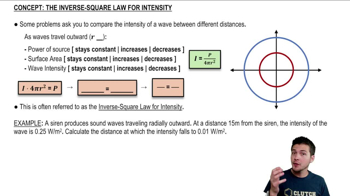
Threshold of Pain. You are investigating the report of a UFO landing in an isolated portion of New Mexico, and you encounter a strange object that is radiating sound waves uniformly in all directions. Assume that the sound comes from a point source and that you can ignore reflections. You are slowly walking toward the source. When you are 7.5 m from it, you measure its intensity to be 0.11 W/m2. An intensity of 1.0 W/m2 is often used as the 'threshold of pain.' How much closer to the source can you move before the sound intensity reaches this threshold?
Energy Output. By measurement you determine that sound waves are spreading out equally in all directions from a point source and that the intensity is 0.026 W/m2 at a distance of 4.3 m from the source. What is the intensity at a distance of 3.1 m from the source?
Verified step by step guidance
Verified video answer for a similar problem:
Key Concepts
Intensity of Sound Waves
Inverse Square Law
Point Source of Sound
A jet plane at takeoff can produce sound of intensity 10.0 W/m2 at 30.0 m away. But you prefer the tranquil sound of normal conversation, which is 1.0 μW/m2. Assume that the plane behaves like a point source of sound. (a) What is the closest dis-tance you should live from the airport runway to preserve your peace of mind? (b) What intensity from the jet does your friend experience if she lives twice as far from the runway as you do? (c) What power of sound does the jet produce at takeoff?
A fellow student with a mathematical bent tells you that the wave function of a traveling wave on a thin rope is . Being more practical, you measure the rope to have a length of and a mass of . You are then asked to determine the following: (d) wave speed; (e) direction the wave is traveling;
A fellow student with a mathematical bent tells you that the wave function of a traveling wave on a thin rope is . Being more practical, you measure the rope to have a length of and a mass of . You are then asked to determine the following: (a) amplitude; (b) frequency; (c) wavelength.
The speed of sound in air at 20°C is 344 m/s. (a) What is the wavelength of a sound wave with a frequency of 784 Hz, corresponding to the note G5 on a piano, and how many milliseconds does each vibration take? (b) What is the wavelength of a sound wave one octave higher (twice the frequency) than the note in part (a)?
Energy Output. By measurement you determine that sound waves are spreading out equally in all directions from a point source and that the intensity is 0.026 W/m2 at a distance of 4.3 m from the source. How much sound energy does the source emit in one hour if its power output remains constant?
