Ch 03: Motion in Two or Three Dimensions
Young & Freedman Calc - University Physics 14th Edition
Young & Freedman Calc14th EditionUniversity PhysicsISBN: 9780321973610Not the one you use?Change textbook
Chapter 3, Problem 4b

The position of a squirrel running in a park is given by r=[(0.280 m/s)t+(0.0360 m/s2)t2]i^+(0.0190 m/s3)t3j^\(\vec{r}\) = \(\left\)[ (0.280~\(\mathrm{m/s}\))t + (0.0360~\(\mathrm{m/s^2}\))t^2 \(\right\)] \(\hat{i}\) + (0.0190~\(\mathrm{m/s^3}\))t^3 \(\hat{j}\). At t=5.00st = 5.00 s, how far is the squirrel from its initial position?

Verified step by step guidance
1
Identify the position function given: \( \mathbf{r}(t) = [(0.280 \text{ m/s})t + (0.0360 \text{ m/s}^2)t^2]\hat{\mathbf{i}} + (0.0190 \text{ m/s}^3)t^3\hat{\mathbf{j}} \). This function describes the position of the squirrel in terms of time \( t \).
To find the position of the squirrel at \( t = 5.00 \text{ s} \), substitute \( t = 5.00 \text{ s} \) into the position function \( \mathbf{r}(t) \). Calculate each component separately: \( \hat{\mathbf{i}} \) and \( \hat{\mathbf{j}} \).
For the \( \hat{\mathbf{i}} \) component, substitute \( t = 5.00 \text{ s} \) into \( (0.280 \text{ m/s})t + (0.0360 \text{ m/s}^2)t^2 \) and compute the value.
For the \( \hat{\mathbf{j}} \) component, substitute \( t = 5.00 \text{ s} \) into \( (0.0190 \text{ m/s}^3)t^3 \) and compute the value.
Combine the computed \( \hat{\mathbf{i}} \) and \( \hat{\mathbf{j}} \) components to find the position vector \( \mathbf{r}(5.00 \text{ s}) \). The magnitude of this vector will give the distance from the initial position at \( t = 0 \text{ s} \). Use the formula \( \sqrt{(\text{component } \hat{\mathbf{i}})^2 + (\text{component } \hat{\mathbf{j}})^2} \) to find the distance.

Verified video answer for a similar problem:

This video solution was recommended by our tutors as helpful for the problem above.
Video duration:
4m
Was this helpful?

Key Concepts

Here are the essential concepts you must grasp in order to answer the question correctly.

Position Vector

The position vector describes the location of an object in space relative to a reference point, often the origin. In this problem, the position vector r is given as a function of time, with components in the î and ĵ directions, representing the squirrel's position in a two-dimensional plane.
Recommended video:
Guided course
07:07
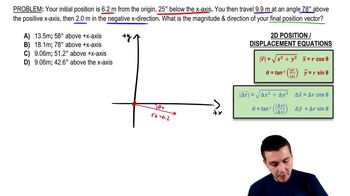
Final Position Vector

Displacement

Displacement is the vector quantity that represents the change in position of an object. It is calculated by finding the difference between the final and initial position vectors. In this problem, the displacement at t = 5.00 s is determined by evaluating the position vector at this time and subtracting the initial position.
Recommended video:
Guided course
06:13
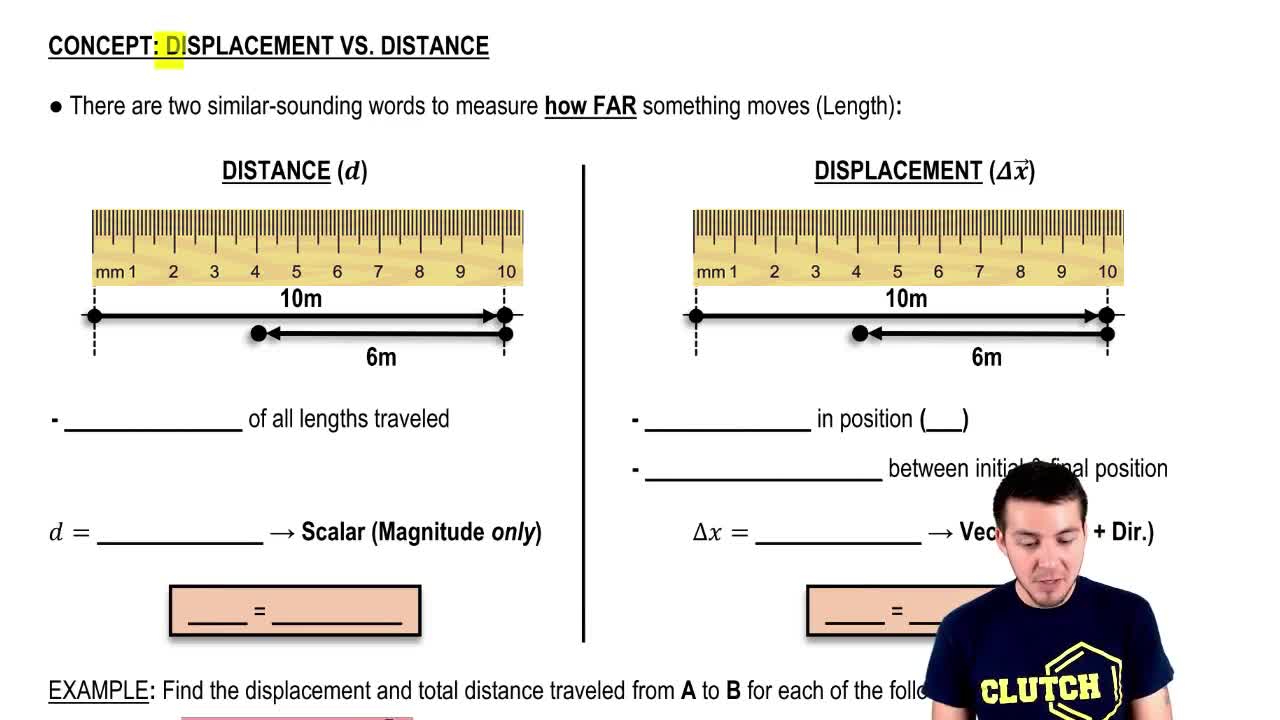
Displacement vs. Distance

Vector Addition

Vector addition involves combining vectors by adding their corresponding components. To find the squirrel's displacement, the components of the position vector at t = 5.00 s are added algebraically. This process involves summing the individual î and ĵ components to determine the total displacement vector.
Recommended video:
Guided course
07:30
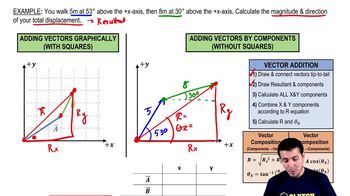
Vector Addition By Components
Related Practice
Textbook Question

The position of a squirrel running in a park is given by r=[(0.280 m/s)t+(0.0360 m/s2)t2]i^+(0.0190 m/s3)t3j^\(\vec{r}\) = \(\left\)[ (0.280~\(\mathrm{m/s}\))t + (0.0360~\(\mathrm{m/s^2}\))t^2 \(\right\)] \(\hat{i}\) + (0.0190~\(\mathrm{m/s^3}\))t^3 \(\hat{j}\). (a) What are vx(t)v_{x}\(\left\)(t\(\right\)) and vy(t)v_{y}\(\left\)(t\(\right\)), the xx-and yy-components of the velocity of the squirrel, as functions of time?

8
views
Textbook Question

A web page designer creates an animation in which a dot on a computer screen has position r=[4.0cm+(2.5 cm/s2)t2]i+(5.0cm/s)tj\(\overrightarrow{r}\)=\(\left\]\lbrack\)4.0\(\operatorname{cm}\)+\(\left\)(2.5\(\text{ cm/s}\)^2\(\right\))t^2\(\right\[\rbrack\]\mathbf{i}\)+\(\left\)(5.0\(\operatorname{\text{cm/s}\)}\(\right\))t\(\mathbf{j}\). Find the magnitude and direction of the dot's average velocity between t=0t = 0 and t=2.0st=2.0s.

2
views
Textbook Question

The coordinates of a bird flying in the xy-plane are given by x(t) = αt and y(t) = 3.0 m − βt2, where α = 2.4 m/s and β = 1.2 m/s2. (a) Sketch the path of the bird between t = 0 and t = 2.0 s.

8
views
Textbook Question

The coordinates of a bird flying in the xy-plane are given by x(t) = αt and y(t) = 3.0 m − βt2, where α = 2.4 m/s and β = 1.2 m/s2. Calculate the velocity and acceleration vectors of the bird as functions of time.

1
views
Textbook Question

A dog running in an open field has components of velocity vx = 2.6 m/s and vy = −1.8 m/s at t1 = 10.0 s. For the time interval from t1 = 10.0 s to t2 = 20.0 s, the average acceleration of the dog has magnitude 0.45 m/s2 and direction 31.0° measured from the +x–axis toward the +y–axis. At t2 = 20.0 s, what are the x- and y-components of the dog's velocity?

6
views