Ch 03: Motion in Two or Three Dimensions
Young & Freedman Calc - University Physics 14th Edition
Young & Freedman Calc14th EditionUniversity PhysicsISBN: 9780321973610Not the one you use?Change textbook
Chapter 3, Problem 7a

The coordinates of a bird flying in the xy-plane are given by x(t) = αt and y(t) = 3.0 m − βt2, where α = 2.4 m/s and β = 1.2 m/s2. (a) Sketch the path of the bird between t = 0 and t = 2.0 s.

Verified step by step guidance
1
Identify the equations of motion for the bird: x(t) = αt and y(t) = 3.0 m − βt², where α = 2.4 m/s and β = 1.2 m/s².
Substitute the given values of α and β into the equations: x(t) = 2.4t and y(t) = 3.0 − 1.2t².
Determine the coordinates of the bird at specific time intervals between t = 0 and t = 2.0 s. For example, calculate x(0), y(0), x(1), y(1), x(2), and y(2).
Plot these coordinates on the xy-plane to visualize the path. Start by marking the points (x(0), y(0)), (x(1), y(1)), and (x(2), y(2)).
Connect the plotted points with a smooth curve to represent the bird's path, noting that the x-coordinate increases linearly while the y-coordinate follows a parabolic trajectory.

Verified video answer for a similar problem:

This video solution was recommended by our tutors as helpful for the problem above.
Video duration:
4m
Was this helpful?

Key Concepts

Here are the essential concepts you must grasp in order to answer the question correctly.

Parametric Equations

Parametric equations express the coordinates of points on a curve as functions of a parameter, often time (t). In this problem, x(t) = αt and y(t) = 3.0 m − βt² describe the bird's position in the xy-plane over time. Understanding these equations helps in plotting the trajectory by calculating x and y for various t values.
Recommended video:
Guided course
08:25
Kinematics Equations

Kinematics in Two Dimensions

Kinematics in two dimensions involves analyzing motion along two axes, typically x and y. The bird's motion is described by its horizontal and vertical components, x(t) and y(t). This concept is crucial for understanding how the bird's position changes over time and how to sketch its path accurately.
Recommended video:
Guided course
08:29
Kinematics in 2D

Graphical Representation of Motion

Graphical representation involves plotting the path of an object based on its position equations. By calculating the bird's x and y coordinates at different time intervals, one can sketch its trajectory on the xy-plane. This visual representation helps in understanding the overall motion pattern and direction of the bird.
Recommended video:
Guided course
05:58
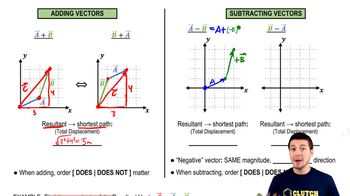
Subtracting Vectors Graphically
Related Practice
Textbook Question

The position of a squirrel running in a park is given by r=[(0.280 m/s)t+(0.0360 m/s2)t2]i^+(0.0190 m/s3)t3j^\(\vec{r}\) = \(\left\)[ (0.280~\(\mathrm{m/s}\))t + (0.0360~\(\mathrm{m/s^2}\))t^2 \(\right\)] \(\hat{i}\) + (0.0190~\(\mathrm{m/s^3}\))t^3 \(\hat{j}\). At t=5.00st = 5.00 s, how far is the squirrel from its initial position?

4
views
Textbook Question

The position of a squirrel running in a park is given by r=[(0.280 m/s)t+(0.0360 m/s2)t2]i^+(0.0190 m/s3)t3j^\(\vec{r}\) = \(\left\)[ (0.280~\(\mathrm{m/s}\))t + (0.0360~\(\mathrm{m/s^2}\))t^2 \(\right\)] \(\hat{i}\) + (0.0190~\(\mathrm{m/s^3}\))t^3 \(\hat{j}\). (a) What are vx(t)v_{x}\(\left\)(t\(\right\)) and vy(t)v_{y}\(\left\)(t\(\right\)), the xx-and yy-components of the velocity of the squirrel, as functions of time?

8
views
Textbook Question

The coordinates of a bird flying in the xy-plane are given by x(t) = αt and y(t) = 3.0 m − βt2, where α = 2.4 m/s and β = 1.2 m/s2. Calculate the magnitude and direction of the bird's velocity and acceleration at t = 2.0 s.

4
views
Textbook Question

The coordinates of a bird flying in the xy-plane are given by x(t) = αt and y(t) = 3.0 m − βt2, where α = 2.4 m/s and β = 1.2 m/s2. Calculate the velocity and acceleration vectors of the bird as functions of time.

1
views
Textbook Question

A remote-controlled car is moving in a vacant parking lot. The velocity of the car as a function of time is given by v=[5.00 m/s(0.0180 m/s3)t2]i^+[2.00 m/s+(0.550 m/s2)t]j^\(\vec{v}\) = \(\left\)[ 5.00~\(\mathrm{m/s}\) - (0.0180~\(\mathrm{m/s^3}\))t^2 \(\right\)] \(\hat{i}\) + \(\left\)[ 2.00~\(\mathrm{m/s}\) + (0.550~\(\mathrm{m/s^2}\))t \(\right\)] \(\hat{j}\). What are ax(t)a_{x}(t) and ay(t)a_{y}(t), the xx- and yy- components of the car's velocity as functions of time?

2
views
Textbook Question

A dog running in an open field has components of velocity vx = 2.6 m/s and vy = −1.8 m/s at t1 = 10.0 s. For the time interval from t1 = 10.0 s to t2 = 20.0 s, the average acceleration of the dog has magnitude 0.45 m/s2 and direction 31.0° measured from the +x–axis toward the +y–axis. At t2 = 20.0 s, what are the x- and y-components of the dog's velocity?

6
views