In a carnival booth, you can win a stuffed giraffe if you toss a quarter into a small dish. The dish is on a shelf above the point where the quarter leaves your hand and is a horizontal distance of 2.1 m from this point (Fig. E3.19). If you toss the coin with a velocity of 6.4 m/s at an angle of 60° above the horizontal, the coin will land in the dish. Ignore air resistance. What is the height of the shelf above the point where the quarter leaves your hand?
On level ground a shell is fired with an initial velocity of 40.0 m/s at 60.0° above the horizontal and feels no appreciable air resistance. At its highest point, find the horizontal and vertical components of its acceleration and velocity.
Verified step by step guidance
Verified video answer for a similar problem:
Key Concepts
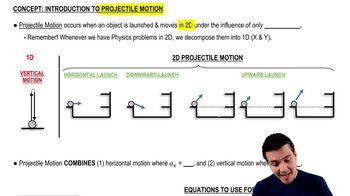
Projectile Motion
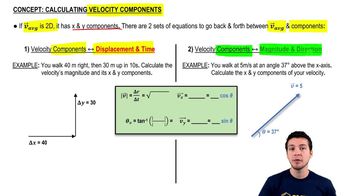
Components of Velocity
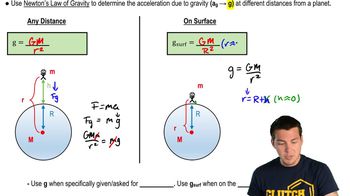
Acceleration Due to Gravity
On level ground a shell is fired with an initial velocity of 40.0 m/s at 60.0° above the horizontal and feels no appreciable air resistance. How long does it take the shell to reach its highest point?
A shot putter releases the shot some distance above the level ground with a velocity of 12.0 m/s, 51.0° above the horizontal. The shot hits the ground 2.08 s later. Ignore air resistance. How far did she throw the shot horizontally?
On level ground a shell is fired with an initial velocity of 40.0 m/s at 60.0° above the horizontal and feels no appreciable air resistance. How far from its firing point does the shell land?
A shot putter releases the shot some distance above the level ground with a velocity of 12.0 m/s, 51.0° above the horizontal. The shot hits the ground 2.08 s later. Ignore air resistance. What are the components of the shot's velocity at the beginning and at the end of its trajectory?
On level ground a shell is fired with an initial velocity of 40.0 m/s at 60.0° above the horizontal and feels no appreciable air resistance. Find its maximum height above the ground.
