Ch 03: Motion in Two or Three Dimensions
Young & Freedman Calc - University Physics 14th Edition
Young & Freedman Calc14th EditionUniversity PhysicsISBN: 9780321973610Not the one you use?Change textbook
Chapter 3, Problem 18b

A shot putter releases the shot some distance above the level ground with a velocity of 12.0 m/s, 51.0° above the horizontal. The shot hits the ground 2.08 s later. Ignore air resistance. What are the components of the shot's velocity at the beginning and at the end of its trajectory?

Verified step by step guidance
1
To find the components of the shot's initial velocity, we need to resolve the velocity vector into horizontal and vertical components using trigonometric functions. The initial velocity is given as 12.0 m/s at an angle of 51.0° above the horizontal.
The horizontal component of the initial velocity (v_x) can be found using the cosine function: v_x = v * cos(θ), where v is the initial velocity and θ is the angle. Substitute the given values: v_x = 12.0 m/s * cos(51.0°).
The vertical component of the initial velocity (v_y) can be found using the sine function: v_y = v * sin(θ). Substitute the given values: v_y = 12.0 m/s * sin(51.0°).
To find the components of the shot's velocity at the end of its trajectory, we need to consider the effect of gravity on the vertical component. The horizontal component remains unchanged as there is no air resistance. The final vertical velocity (v_y_final) can be calculated using the equation: v_y_final = v_y_initial - g * t, where g is the acceleration due to gravity (9.8 m/s²) and t is the time (2.08 s).
The final horizontal component of the velocity (v_x_final) is the same as the initial horizontal component since there is no air resistance: v_x_final = v_x_initial. Therefore, the final velocity components are v_x_final and v_y_final.

Verified video answer for a similar problem:

This video solution was recommended by our tutors as helpful for the problem above.
Video duration:
8m
Was this helpful?

Key Concepts

Here are the essential concepts you must grasp in order to answer the question correctly.

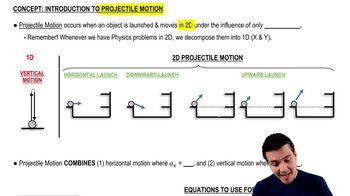
Projectile Motion

Projectile motion involves the motion of an object thrown or projected into the air, subject to only the acceleration of gravity. It is characterized by a parabolic trajectory due to the influence of gravity acting downward, while the initial velocity has both horizontal and vertical components.
Recommended video:
Guided course
04:44
Introduction to Projectile Motion

Velocity Components

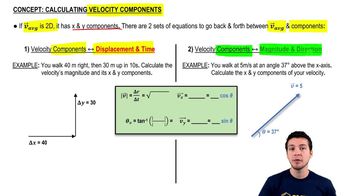
Velocity components refer to the breakdown of a vector into its horizontal and vertical parts. For a projectile, the initial velocity can be split into horizontal (vx = v * cos(θ)) and vertical (vy = v * sin(θ)) components, where v is the magnitude of the velocity and θ is the angle of projection.
Recommended video:
Guided course
05:53
Calculating Velocity Components

Kinematic Equations

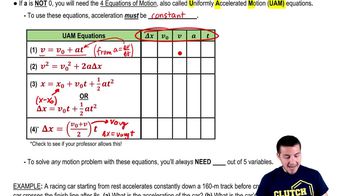
Kinematic equations describe the motion of objects without considering the forces that cause the motion. They are used to calculate the position, velocity, and acceleration of an object over time. For projectile motion, these equations help determine the velocity at different points in the trajectory, considering constant acceleration due to gravity.
Recommended video:
Guided course
08:25
Kinematics Equations
Related Practice
Textbook Question

In a carnival booth, you can win a stuffed giraffe if you toss a quarter into a small dish. The dish is on a shelf above the point where the quarter leaves your hand and is a horizontal distance of 2.1 m from this point (Fig. E3.19). If you toss the coin with a velocity of 6.4 m/s at an angle of 60° above the horizontal, the coin will land in the dish. Ignore air resistance. What is the height of the shelf above the point where the quarter leaves your hand?

3
views
Textbook Question

In a carnival booth, you can win a stuffed giraffe if you toss a quarter into a small dish. The dish is on a shelf above the point where the quarter leaves your hand and is a horizontal distance of 2.1 m from this point (Fig. E3.19). If you toss the coin with a velocity of 6.4 m/s at an angle of 60° above the horizontal, the coin will land in the dish. Ignore air resistance. What is the vertical component of the velocity of the quarter just before it lands in the dish?

1
views
Textbook Question

A shot putter releases the shot some distance above the level ground with a velocity of 12.0 m/s, 51.0° above the horizontal. The shot hits the ground 2.08 s later. Ignore air resistance. How far did she throw the shot horizontally?

1
views
Textbook Question

On level ground a shell is fired with an initial velocity of 40.0 m/s at 60.0° above the horizontal and feels no appreciable air resistance. How far from its firing point does the shell land?

3
views
Textbook Question

On level ground a shell is fired with an initial velocity of 40.0 m/s at 60.0° above the horizontal and feels no appreciable air resistance. Find its maximum height above the ground.

2
views
Textbook Question

On level ground a shell is fired with an initial velocity of 40.0 m/s at 60.0° above the horizontal and feels no appreciable air resistance. At its highest point, find the horizontal and vertical components of its acceleration and velocity.

3
views