Ch 02: Motion Along a Straight Line
Young & Freedman Calc - University Physics 14th Edition
Young & Freedman Calc14th EditionUniversity PhysicsISBN: 9780321973610Not the one you use?Change textbook
Chapter 2, Problem 46b

An egg is thrown nearly vertically upward from a point near the cornice of a tall building. The egg just misses the cornice on the way down and passes a point 30.030.0 m below its starting point 5.005.00 s after it leaves the thrower's hand. Ignore air resistance. How high does it rise above its starting point?

Verified step by step guidance
1
Identify the known values: the displacement of the egg is 30.0 m downward, the time taken is 5.00 s, and the acceleration due to gravity is approximately 9.81 m/s² downward.
Use the kinematic equation for displacement: s=v0t+12at^2, where s is the displacement, v0 is the initial velocity, t is the time, and a is the acceleration.
Rearrange the equation to solve for the initial velocity v0: v0=s-12at^2t. Substitute the known values to find v0.
Determine the maximum height reached using the formula: vf^2=v0^2-2ah, where vf is the final velocity (0 m/s at the peak), h is the height above the starting point.
Solve for h using the rearranged equation: h=v0^22a. Substitute the calculated initial velocity and known acceleration to find the height.

Verified video answer for a similar problem:

This video solution was recommended by our tutors as helpful for the problem above.
Video duration:
5m
Was this helpful?

Key Concepts

Here are the essential concepts you must grasp in order to answer the question correctly.

Kinematics Equations

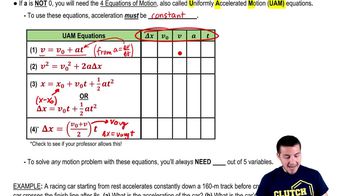
Kinematics equations describe the motion of objects under constant acceleration. They relate displacement, initial velocity, final velocity, acceleration, and time. In this problem, these equations help determine the maximum height reached by the egg by analyzing its vertical motion, given the time and displacement.
Recommended video:
Guided course
08:25
Kinematics Equations

Free Fall Motion

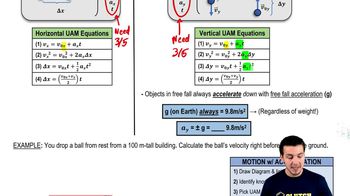
Free fall motion refers to the movement of an object under the influence of gravitational force alone. In this scenario, the egg is subject to Earth's gravity, which accelerates it downward at approximately 9.81 m/s². Understanding free fall is crucial to calculate how high the egg rises before gravity slows it to a stop.
Recommended video:
Guided course
08:36
Vertical Motion & Free Fall

Initial Velocity

Initial velocity is the speed and direction of an object at the start of its motion. It is a critical factor in determining the egg's trajectory and maximum height. By knowing the initial velocity, one can use kinematic equations to find out how high the egg travels before gravity brings it back down.
Recommended video:
Guided course
7:27
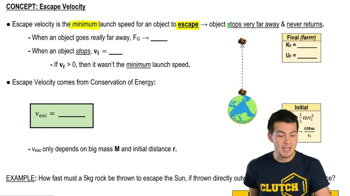
Escape Velocity
Related Practice
Textbook Question

An egg is thrown nearly vertically upward from a point near the cornice of a tall building. The egg just misses the cornice on the way down and passes a point 30.030.0 m below its starting point 5.005.00 s after it leaves the thrower's hand. Ignore air resistance. What is the initial speed of the egg?

2
views
Textbook Question

A hot-air balloonist, rising vertically with a constant velocity of magnitude 5.005.00 m/s, releases a sandbag at an instant when the balloon is 40.040.0 m above the ground (Fig. E2.442.44). After the sandbag is released, it is in free fall. What is the greatest height above the ground that the sandbag reaches?

Textbook Question

A hot-air balloonist, rising vertically with a constant velocity of magnitude 5.005.00 m/s, releases a sandbag at an instant when the balloon is 40.040.0 m above the ground (Fig. E2.442.44). After the sandbag is released, it is in free fall. Compute the position and velocity of the sandbag at 0.2500.250 s and 1.001.00 s after its release.

2
views
Textbook Question

An egg is thrown nearly vertically upward from a point near the cornice of a tall building. The egg just misses the cornice on the way down and passes a point 30.030.0 m below its starting point 5.005.00 s after it leaves the thrower's hand. Ignore air resistance. What is the magnitude of its velocity at the highest point?

2
views
Textbook Question

A 1515-kg rock is dropped from rest on the earth and reaches the ground in 1.751.75 s. When it is dropped from the same height on Saturn's satellite Enceladus, the rock reaches the ground in 18.618.6 s. What is the acceleration due to gravity on Enceladus?

1
views
Textbook Question

An egg is thrown nearly vertically upward from a point near the cornice of a tall building. The egg just misses the cornice on the way down and passes a point 30.030.0 m below its starting point 5.005.00 s after it leaves the thrower's hand. Ignore air resistance. What are the magnitude and direction of its acceleration at the highest point?

2
views