Ch 02: Motion Along a Straight Line
Young & Freedman Calc - University Physics 14th Edition
Young & Freedman Calc14th EditionUniversity PhysicsISBN: 9780321973610Not the one you use?Change textbook
Chapter 2, Problem 46a

An egg is thrown nearly vertically upward from a point near the cornice of a tall building. The egg just misses the cornice on the way down and passes a point 30.030.0 m below its starting point 5.005.00 s after it leaves the thrower's hand. Ignore air resistance. What is the initial speed of the egg?

Verified step by step guidance
1
Start by identifying the known values: the displacement of the egg is 30.0 m downward, the time taken is 5.00 s, and the acceleration due to gravity is approximately 9.81 m/s² downward.
Use the kinematic equation for vertical motion: y=v0t-12gt^2, where y is the displacement, v0 is the initial velocity, t is the time, and g is the acceleration due to gravity.
Substitute the known values into the equation: -30.0=v0(5.00)-12(9.81)(5.00)^2.
Rearrange the equation to solve for the initial velocity v0: v0=-30.0+12(9.81)(5.00)^2.
Calculate the expression to find the initial speed of the egg, ensuring to keep track of units and signs throughout the calculation.

Verified video answer for a similar problem:

This video solution was recommended by our tutors as helpful for the problem above.
Video duration:
4m
Was this helpful?

Key Concepts

Here are the essential concepts you must grasp in order to answer the question correctly.

Kinematics Equations

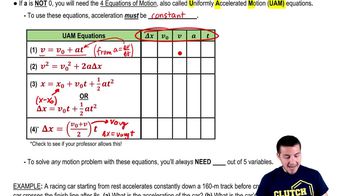
Kinematics equations describe the motion of objects without considering the forces that cause the motion. For vertical motion under gravity, the key equations relate displacement, initial velocity, time, and acceleration due to gravity. These equations are essential for calculating the initial speed of the egg based on its displacement and time.
Recommended video:
Guided course
08:25
Kinematics Equations

Acceleration due to Gravity

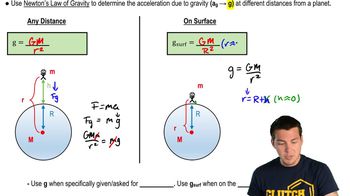
Acceleration due to gravity is a constant force acting on objects near Earth's surface, typically approximated as 9.81 m/s² downward. This concept is crucial for understanding the egg's motion, as it influences the egg's velocity and displacement over time, allowing us to calculate its initial speed.
Recommended video:
Guided course
05:20
Acceleration Due to Gravity

Vertical Motion

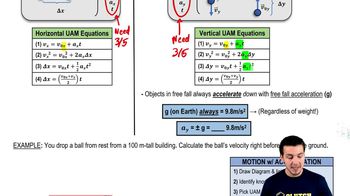
Vertical motion involves objects moving up or down under the influence of gravity. Understanding vertical motion is key to solving the problem, as it involves analyzing the egg's trajectory, including its upward and downward paths, to determine the initial speed required to reach a specific displacement in a given time.
Recommended video:
Guided course
08:36
Vertical Motion & Free Fall
Related Practice
Textbook Question

A hot-air balloonist, rising vertically with a constant velocity of magnitude 5.005.00 m/s, releases a sandbag at an instant when the balloon is 40.040.0 m above the ground (Fig. E2.442.44). After the sandbag is released, it is in free fall. What is the greatest height above the ground that the sandbag reaches?

Textbook Question

A hot-air balloonist, rising vertically with a constant velocity of magnitude 5.005.00 m/s, releases a sandbag at an instant when the balloon is 40.040.0 m above the ground (Fig. E2.442.44). After the sandbag is released, it is in free fall. Compute the position and velocity of the sandbag at 0.2500.250 s and 1.001.00 s after its release.

2
views
Textbook Question

An egg is thrown nearly vertically upward from a point near the cornice of a tall building. The egg just misses the cornice on the way down and passes a point 30.030.0 m below its starting point 5.005.00 s after it leaves the thrower's hand. Ignore air resistance. What is the magnitude of its velocity at the highest point?

2
views
Textbook Question

An egg is thrown nearly vertically upward from a point near the cornice of a tall building. The egg just misses the cornice on the way down and passes a point 30.030.0 m below its starting point 5.005.00 s after it leaves the thrower's hand. Ignore air resistance. How high does it rise above its starting point?

2
views
Textbook Question

A 75007500-kg rocket blasts off vertically from the launch pad with a constant upward acceleration of 2.252.25 m/s2 and feels no appreciable air resistance. When it has reached a height of 525525 m, its engines suddenly fail; the only force acting on it is now gravity. How much time will elapse after engine failure before the rocket comes crashing down to the launch pad, and how fast will it be moving just before it crashes?

2
views
Textbook Question

An egg is thrown nearly vertically upward from a point near the cornice of a tall building. The egg just misses the cornice on the way down and passes a point 30.030.0 m below its starting point 5.005.00 s after it leaves the thrower's hand. Ignore air resistance. What are the magnitude and direction of its acceleration at the highest point?

2
views