Ch 41: Atomic Physics
Knight Calc - Physics for Scientists and Engineers 5th Edition
Knight Calc5th EditionPhysics for Scientists and EngineersISBN: 9780137344796Not the one you use?Change textbook
Chapter 41, Problem 40

A sodium atom emits a photon with wavelength 818 nm shortly after being struck by an electron. What minimum speed did the electron have before the collision?

Verified step by step guidance
1
Step 1: Begin by understanding the relationship between the energy of the emitted photon and its wavelength. Use the formula for photon energy: E=hcλ, where h is Planck's constant (6.63×1034 J·s), c is the speed of light (3.00×10 m/s), and λ is the wavelength of the photon (818 nm, converted to meters as 818×109 m).
Step 2: Calculate the energy of the photon using the formula from Step 1. This energy represents the minimum energy transferred to the sodium atom during the collision.
Step 3: Recognize that the electron must have had at least this amount of kinetic energy before the collision to transfer it to the sodium atom. Use the kinetic energy formula for the electron: K=12mv2, where m is the mass of the electron (9.11×1031 kg) and v is its speed.
Step 4: Rearrange the kinetic energy formula to solve for the speed of the electron: v=2Km. Substitute the energy of the photon (calculated in Step 2) for K and the mass of the electron for m.
Step 5: Perform the substitution and simplify the expression to find the minimum speed of the electron. This speed corresponds to the energy required to emit the photon with a wavelength of 818 nm.

Verified video answer for a similar problem:

This video solution was recommended by our tutors as helpful for the problem above.
Video duration:
5m
Was this helpful?

Key Concepts

Here are the essential concepts you must grasp in order to answer the question correctly.

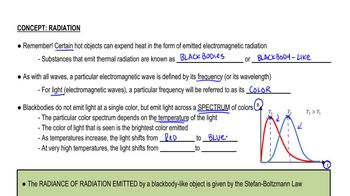
Photon Emission

Photon emission occurs when an atom transitions from a higher energy state to a lower energy state, releasing energy in the form of light. The wavelength of the emitted photon is inversely related to the energy difference between these states, as described by the equation E = hc/λ, where E is energy, h is Planck's constant, c is the speed of light, and λ is the wavelength.
Recommended video:

Energy Conservation

In physics, the principle of energy conservation states that energy cannot be created or destroyed, only transformed from one form to another. In this scenario, the kinetic energy of the incoming electron is converted into the energy of the emitted photon, allowing us to relate the electron's speed to the energy of the photon produced.
Recommended video:
Guided course
06:24
Conservation Of Mechanical Energy

Kinetic Energy

Kinetic energy is the energy possessed by an object due to its motion, calculated using the formula KE = 1/2 mv², where m is mass and v is velocity. To find the minimum speed of the electron, we can equate its kinetic energy to the energy of the emitted photon, allowing us to solve for the electron's initial speed before the collision.
Recommended video:
Guided course
06:07
Intro to Rotational Kinetic Energy