Ch 41: Atomic Physics
Knight Calc - Physics for Scientists and Engineers 5th Edition
Knight Calc5th EditionPhysics for Scientists and EngineersISBN: 9780137344796Not the one you use?Change textbook
Chapter 41, Problem 49

A ruby laser emits a 100 MW, 10-ns-long pulse of light with a wavelength of 690 nm. How many chromium atoms undergo stimulated emission to generate this pulse?

Verified step by step guidance
1
Determine the energy of a single photon emitted by the laser using the formula: \( E = \frac{hc}{\lambda} \), where \( h \) is Planck's constant (\( 6.626 \times 10^{-34} \, \text{J·s} \)), \( c \) is the speed of light (\( 3.00 \times 10^8 \; \text{m/s} \)), and \( \lambda \) is the wavelength of the light (\( 690 \; \text{nm} = 690 \times 10^{-9} \; \text{m} \)).
Calculate the total energy of the laser pulse using the formula: \( E_{\text{pulse}} = P \cdot t \), where \( P \) is the power of the laser pulse (\( 100 \; \text{MW} = 100 \times 10^6 \; \text{W} \)) and \( t \) is the duration of the pulse (\( 10 \; \text{ns} = 10 \times 10^{-9} \; \text{s} \)).
Determine the number of photons in the laser pulse by dividing the total energy of the pulse by the energy of a single photon: \( N = \frac{E_{\text{pulse}}}{E} \).
Recognize that each photon corresponds to one chromium atom undergoing stimulated emission. Therefore, the number of photons calculated in the previous step is equal to the number of chromium atoms that undergo stimulated emission.
Summarize the process: First, calculate the energy of a single photon. Then, calculate the total energy of the laser pulse. Finally, divide the total energy by the energy of a single photon to find the number of chromium atoms involved in stimulated emission.

Verified video answer for a similar problem:

This video solution was recommended by our tutors as helpful for the problem above.
Was this helpful?

Key Concepts

Here are the essential concepts you must grasp in order to answer the question correctly.

Stimulated Emission

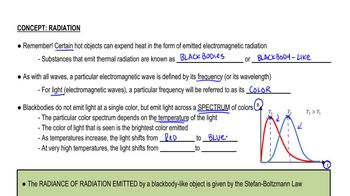
Stimulated emission is a process where an incoming photon of a specific energy stimulates an excited atom to emit a second photon of the same energy, phase, and direction. This is the fundamental principle behind laser operation, allowing for the amplification of light. In the context of the ruby laser, chromium atoms are the active medium that undergo stimulated emission to produce coherent light.
Recommended video:

Photon Energy and Wavelength

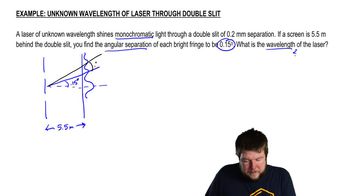
The energy of a photon is inversely related to its wavelength, described by the equation E = hc/λ, where E is energy, h is Planck's constant, c is the speed of light, and λ is the wavelength. For the ruby laser emitting light at 690 nm, understanding the energy of the emitted photons is crucial for calculating how many chromium atoms are involved in the stimulated emission process to generate the pulse.
Recommended video:
Guided course
05:42
Unknown Wavelength of Laser through Double Slit

Power and Energy Relationship

Power is defined as the rate at which energy is transferred or converted, expressed in watts (W). In this case, the ruby laser emits a pulse of 100 MW for 10 ns, which can be converted into total energy using the formula Energy = Power × Time. This total energy can then be used to determine the number of photons emitted and, consequently, the number of chromium atoms that underwent stimulated emission.
Recommended video:
Guided course
03:43
Relationships Between Force, Field, Energy, Potential