
Ch 40: One-Dimensional Quantum Mechanics
Knight Calc - Physics for Scientists and Engineers 5th Edition
Knight Calc5th EditionPhysics for Scientists and EngineersISBN: 9780137344796Not the one you use?Change textbook
Chapter 40, Problem 42c

CALC A particle of mass m has the wave function ψ(x) = Ax exp (−x²/a²) when it is in an allowed energy level with E = 0. Find and graph the potential-energy function U(x).

Verified step by step guidance
1
Step 1: Recall the relationship between the potential energy function U(x), the wave function ψ(x), and the total energy E in the Schrödinger equation. The time-independent Schrödinger equation is given by: −(ℏ²/2m)(d²ψ/dx²) + U(x)ψ = Eψ. Here, E is the total energy, which is given as 0 in this problem.
Step 2: Substitute the given wave function ψ(x) = A exp(−x²/a²) into the Schrödinger equation. First, compute the first and second derivatives of ψ(x) with respect to x. The first derivative is: dψ/dx = −(2x/a²)A exp(−x²/a²). The second derivative is: d²ψ/dx² = A exp(−x²/a²) [(4x²/a⁴) − (2/a²)].
Step 3: Substitute d²ψ/dx² and ψ(x) into the Schrödinger equation. Since E = 0, the equation simplifies to: −(ℏ²/2m)(d²ψ/dx²) + U(x)ψ = 0. Rearrange to solve for U(x): U(x) = (ℏ²/2m)(1/ψ)(d²ψ/dx²).
Step 4: Substitute the expressions for ψ(x) and d²ψ/dx² into the formula for U(x). After simplification, you will find that the potential energy function is: U(x) = (ℏ²/2m)[(4x²/a⁴) − (2/a²)]. This represents a harmonic oscillator-like potential with an additional constant term.
Step 5: To graph U(x), note that it is a parabolic function of x with a minimum at x = 0. The term (4x²/a⁴) dominates for large |x|, causing U(x) to increase quadratically. Plot U(x) as a function of x, showing a parabola centered at x = 0 with its shape determined by the constants , m, and a.

Verified video answer for a similar problem:

This video solution was recommended by our tutors as helpful for the problem above.
Video duration:
10m
Was this helpful?

Key Concepts

Here are the essential concepts you must grasp in order to answer the question correctly.

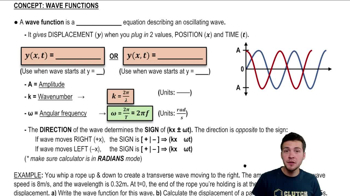
Wave Function

The wave function, denoted as ψ(x), describes the quantum state of a particle in quantum mechanics. It contains all the information about the system, including the probability distribution of a particle's position. In this case, the given wave function indicates how the particle's position is distributed in space, which is crucial for determining its energy and potential energy.
Recommended video:
Guided course
08:30
Intro to Wave Functions

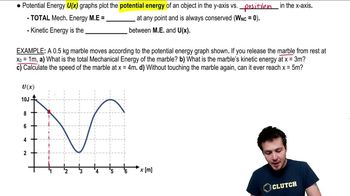
Potential Energy Function

The potential energy function U(x) represents the potential energy of a particle as a function of its position x. In quantum mechanics, it is often derived from the wave function and the total energy of the system. For a particle in a bound state, the potential energy can be inferred from the behavior of the wave function, particularly its shape and the energy level it corresponds to.
Recommended video:
Guided course
07:24
Potential Energy Graphs

Energy Levels in Quantum Mechanics

Energy levels in quantum mechanics refer to the discrete values of energy that a quantum system can have. For a particle in a potential well, these levels are quantized, meaning the particle can only occupy specific energy states. The problem states that the energy E=0, indicating that the particle is in a specific state that can help determine the form of the potential energy function U(x) based on the wave function provided.
Recommended video:
Guided course
06:24
Conservation Of Mechanical Energy
Related Practice
Textbook Question

In a nuclear physics experiment, a proton is fired toward a Z = 13 nucleus with the diameter and neutron energy levels shown in Figure 40.17. The nucleus, which was initially in its ground state, subsequently emits a gamma ray with wavelength 1.73×10⁻⁴ nm. What was the minimum initial speed of the proton? Hint: Don't neglect the proton-nucleus collision.

6
views
Textbook Question

CALC A particle of mass m has the wave function ψ(x) = Ax exp (−x²/a²) when it is in an allowed energy level with E = 0. Draw a graph of ψ(x) versus x.

2
views
Textbook Question

CALC A particle of mass m has the wave function ψ(x) = Ax exp (−x²/a²) when it is in an allowed energy level with E = 0. At what value or values of x is the particle most likely to be found?

2
views
Textbook Question

Figure 40.17 showed that a typical nuclear radius is 4.0 fm. As you’ll learn in Chapter 42, a typical energy of a neutron bound inside the nuclear potential well is En = −20 MeV. To find out how “fuzzy” the edge of the nucleus is, what is the neutron’s penetration distance into the classically forbidden region as a fraction of the nuclear radius?

2
views
Textbook Question

CALC Determine the normalization constant A1 for the n = 1 ground-state wave function of the quantum harmonic oscillator. Your answer will be in terms of b.

1
views
Textbook Question

A proton’s energy is 1.0 MeV below the top of a 10-fm-wide energy barrier. What is the probability that the proton will tunnel through the barrier?

1
views