
Ch 40: One-Dimensional Quantum Mechanics
Knight Calc - Physics for Scientists and Engineers 5th Edition
Knight Calc5th EditionPhysics for Scientists and EngineersISBN: 9780137344796Not the one you use?Change textbook
Chapter 40, Problem 42a

CALC A particle of mass m has the wave function ψ(x) = Ax exp (−x²/a²) when it is in an allowed energy level with E = 0. Draw a graph of ψ(x) versus x.

Verified step by step guidance
1
Understand the given wave function: ψ(x) = Ax exp(−x²/a²). This is a Gaussian function, which is symmetric about x = 0 and decreases exponentially as x moves away from the origin.
Identify the parameters in the wave function: 'A' is the normalization constant, 'a' determines the width of the Gaussian curve, and 'x' is the position variable.
Recognize that the graph of ψ(x) versus x will have a peak at x = 0 (since exp(−x²/a²) is maximum at x = 0) and will symmetrically decrease on both sides of the origin.
Sketch the graph qualitatively: Start by plotting a bell-shaped curve centered at x = 0. Ensure the curve is symmetric about the y-axis and approaches zero as x → ±∞.
Label the axes: The x-axis represents the position variable 'x', and the y-axis represents the wave function ψ(x). Indicate the peak at x = 0 and the gradual decay of the function as x moves away from the origin.

Key Concepts

Here are the essential concepts you must grasp in order to answer the question correctly.

Wave Function

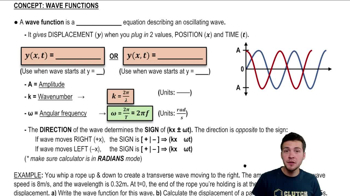
The wave function, denoted as ψ(x), describes the quantum state of a particle in quantum mechanics. It contains all the information about the system and is used to calculate probabilities of finding a particle in a particular position. The square of the wave function's absolute value, |ψ(x)|², gives the probability density of the particle's position.
Recommended video:
Guided course
08:30
Intro to Wave Functions

Gaussian Function

The given wave function includes an exponential term exp(−x²/a²), which is a Gaussian function. This function is characterized by its bell-shaped curve, centered at x=0, and it rapidly decreases as x moves away from the center. Gaussian functions are significant in quantum mechanics as they often represent the probability distributions of particles.
Recommended video:
Guided course
08:30
Intro to Wave Functions

Normalization

Normalization is a crucial concept in quantum mechanics that ensures the total probability of finding a particle in all space equals one. For the wave function ψ(x) to be physically meaningful, it must be normalized, which involves determining the constant A such that the integral of |ψ(x)|² over all space equals one. This process is essential for accurately interpreting the wave function's probabilities.
Recommended video:
Guided course
08:17
The Normal Force