Ch 39: Wave Functions and Uncertainty
Knight Calc - Physics for Scientists and Engineers 5th Edition
Knight Calc5th EditionPhysics for Scientists and EngineersISBN: 9780137344796Not the one you use?Change textbook
Chapter 39, Problem 14c

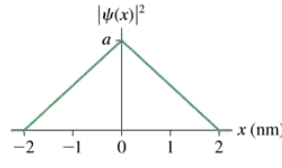
FIGURE EX39.14 is a graph of |ψ(x)|2 for an electron. What is the probability that the electron is located between x = 1.0 nm and x = 2.0 nm?

Verified step by step guidance
1
Step 1: Understand the problem. The graph of |ψ(x)|² represents the probability density function for the electron's position. To find the probability that the electron is located between x = 1.0 nm and x = 2.0 nm, we need to integrate |ψ(x)|² over this interval.
Step 2: Write the integral expression for the probability. The probability P is given by: P = ∫1.02.0|ψ(x)|² dx. This integral calculates the area under the curve of |ψ(x)|² between x = 1.0 nm and x = 2.0 nm.
Step 3: Analyze the graph of |ψ(x)|² provided in FIGURE EX39.14. Identify the functional form of |ψ(x)|² or approximate the values if the graph is discrete or irregular. If the graph provides a specific function, substitute it into the integral.
Step 4: Perform the integration. Depending on the functional form of |ψ(x)|², use appropriate integration techniques (e.g., analytical integration for simple functions or numerical methods for complex or discrete data). Ensure the limits of integration are x = 1.0 nm and x = 2.0 nm.
Step 5: Interpret the result of the integration. The value obtained from the integral represents the probability that the electron is located between x = 1.0 nm and x = 2.0 nm. Ensure the result is consistent with the physical interpretation of probabilities (i.e., it should be a number between 0 and 1).

Verified video answer for a similar problem:

This video solution was recommended by our tutors as helpful for the problem above.
Video duration:
6m
Was this helpful?

Key Concepts

Here are the essential concepts you must grasp in order to answer the question correctly.

Wave Function and Probability Density

In quantum mechanics, the wave function, denoted as ψ(x), describes the quantum state of a particle. The square of the absolute value of the wave function, |ψ(x)|^2, represents the probability density, indicating the likelihood of finding the particle at a specific position. This concept is fundamental for understanding how quantum particles behave and how their locations can be predicted.
Recommended video:
Guided course
08:30
Intro to Wave Functions

Integration of Probability Density

To find the probability of a particle being located within a specific range, one must integrate the probability density over that range. For the given question, this involves calculating the integral of |ψ(x)|^2 from x=1.0 nm to x=2.0 nm. This process quantifies the total probability of finding the electron in the specified interval, which is a key aspect of quantum mechanics.
Recommended video:
Guided course
11:43
Finding Moment Of Inertia By Integrating

Normalization of the Wave Function

The wave function must be normalized, meaning that the total probability of finding the particle in all space equals one. This ensures that the probabilities derived from |ψ(x)|^2 are meaningful. Normalization is crucial for accurate calculations in quantum mechanics, as it establishes a consistent framework for interpreting probabilities associated with particle locations.
Recommended video:
Guided course
08:30
Intro to Wave Functions