Ch 39: Wave Functions and Uncertainty
Knight Calc - Physics for Scientists and Engineers 5th Edition
Knight Calc5th EditionPhysics for Scientists and EngineersISBN: 9780137344796Not the one you use?Change textbook
Chapter 39, Problem 14a

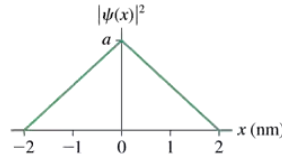
FIGURE EX39.14 is a graph of |ψ(x)|2 for an electron. What is the value of a?

Verified step by step guidance
1
Understand the problem: The graph of |ψ(x)|² represents the probability density function of the electron's position. The value of 'a' is likely a parameter related to the spatial extent or characteristic length scale of the wavefunction. This could be inferred from the graph's features, such as its width or periodicity.
Analyze the graph: Examine the graph of |ψ(x)|² to identify key features such as the distance between peaks (if periodic), the width of the central peak, or any other characteristic length scale. These features are often related to 'a' in quantum mechanics problems.
Relate the graph to the wavefunction: Recall that |ψ(x)|² is the square of the wavefunction ψ(x). If the wavefunction is given by a specific form (e.g., a Gaussian or sinusoidal function), 'a' might represent a parameter such as the standard deviation of a Gaussian or the wavelength of a sinusoidal function.
Use the mathematical relationship: If the wavefunction is known or can be inferred, write down its mathematical form. For example, if ψ(x) = A * exp(-x² / (2a²)), then 'a' is the parameter that determines the width of the Gaussian. Alternatively, if ψ(x) = A * sin(πx / a), then 'a' is related to the wavelength or periodicity.
Determine 'a' from the graph: Measure the relevant feature from the graph (e.g., the full width at half maximum for a Gaussian or the distance between peaks for a sinusoidal function). Use this measurement in the mathematical relationship to solve for 'a'.

Verified video answer for a similar problem:

This video solution was recommended by our tutors as helpful for the problem above.
Was this helpful?

Key Concepts

Here are the essential concepts you must grasp in order to answer the question correctly.

Wave Function (ψ)

The wave function, denoted as ψ, is a fundamental concept in quantum mechanics that describes the quantum state of a particle. It contains all the information about the system and is a complex-valued function of position and time. The square of the absolute value of the wave function, |ψ(x)|^2, represents the probability density of finding the particle at a given position x.
Recommended video:
Guided course
08:30
Intro to Wave Functions

Probability Density

Probability density is a measure used in quantum mechanics to determine the likelihood of finding a particle in a specific region of space. It is derived from the wave function, where |ψ(x)|^2 gives the probability per unit length for a one-dimensional system. Understanding probability density is crucial for interpreting the results of quantum experiments and predicting particle behavior.
Recommended video:
Guided course
8:13
Intro to Density

Normalization Condition

The normalization condition is a requirement in quantum mechanics that ensures the total probability of finding a particle in all space equals one. Mathematically, this is expressed as the integral of |ψ(x)|^2 over all space being equal to one. This condition is essential for the physical interpretation of the wave function and ensures that the probabilities derived from it are meaningful.
Recommended video:
Guided course
08:17
The Normal Force