Ch 38: Quantization
Knight Calc - Physics for Scientists and Engineers 5th Edition
Knight Calc5th EditionPhysics for Scientists and EngineersISBN: 9780137344796Not the one you use?Change textbook
Chapter 38, Problem 14

What is the energy, in keV, of 75 keV x-ray photons that are backscattered (i.e., scattered directly back toward the source) by the electrons in a target?

Verified step by step guidance
1
Understand the problem: The energy of the backscattered photon can be determined using the Compton scattering formula. This involves the relationship between the initial photon energy, the scattering angle (180° for backscattering), and the energy of the scattered photon.
Write the Compton wavelength shift formula: Δλ = λ' - λ = (h / (m_e * c)) * (1 - cos(θ)), where h is Planck's constant, m_e is the electron mass, c is the speed of light, λ is the initial wavelength, λ' is the scattered wavelength, and θ is the scattering angle (180° for backscattering).
Relate the wavelength to energy: Use the formula E = h * c / λ to express the initial and scattered photon energies in terms of their respective wavelengths. The initial energy is given as 75 keV, so calculate the initial wavelength λ using this formula.
Substitute the values into the Compton formula: Use the known constants (h, m_e, c) and the scattering angle θ = 180° to calculate the wavelength shift Δλ. Then, find the scattered wavelength λ' by adding Δλ to the initial wavelength λ.
Determine the energy of the backscattered photon: Use the formula E' = h * c / λ' to calculate the energy of the scattered photon in keV. This will give the energy of the backscattered photon.

Verified video answer for a similar problem:

This video solution was recommended by our tutors as helpful for the problem above.
Was this helpful?

Key Concepts

Here are the essential concepts you must grasp in order to answer the question correctly.

Photon Energy

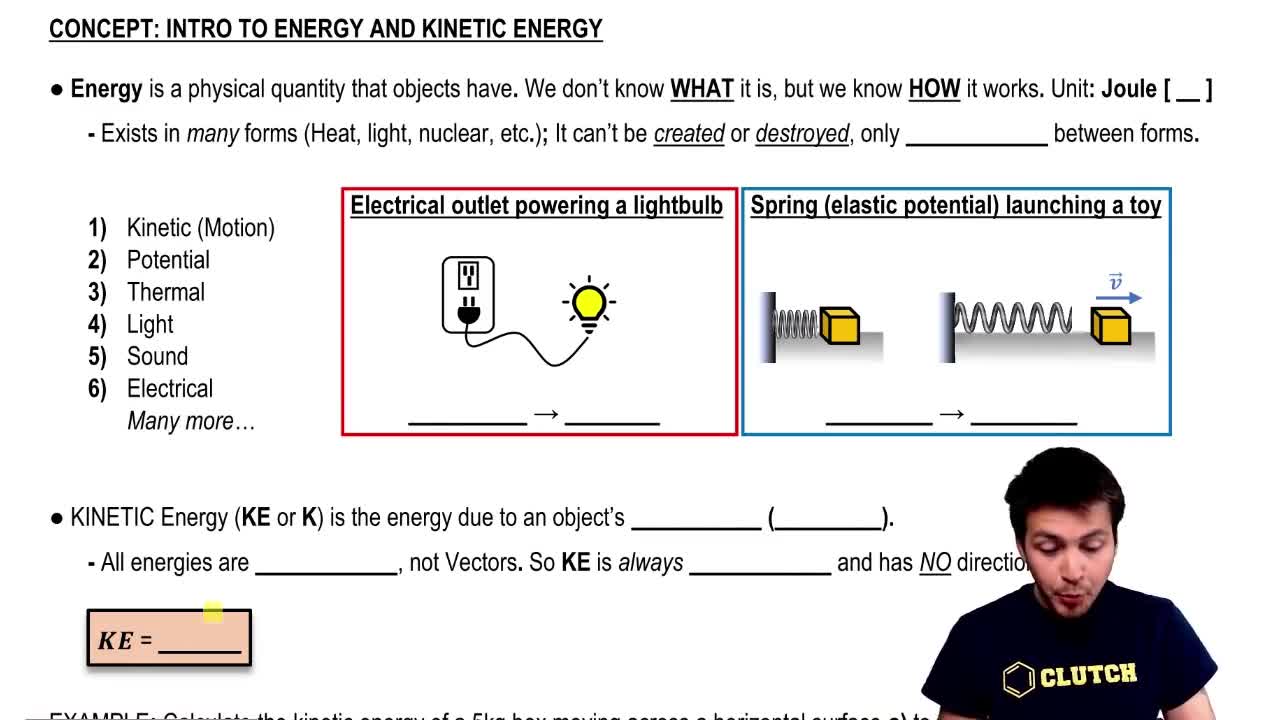
Photon energy is defined by the equation E = hf, where E is energy, h is Planck's constant, and f is the frequency of the photon. In the context of x-rays, the energy is often expressed in electronvolts (eV) or kiloelectronvolts (keV), with 1 keV equal to 1,000 eV. Understanding photon energy is crucial for analyzing interactions between photons and matter.
Recommended video:
Guided course
04:10
Intro to Energy & Types of Energy

Backscattering

Backscattering refers to the phenomenon where particles, such as photons or electrons, are deflected back toward their source after colliding with a target. In the case of x-ray photons, backscattering can occur when photons interact with electrons in a material, leading to a change in direction and energy. This concept is important for understanding how x-rays interact with matter and the implications for imaging and radiation therapy.

Compton Scattering

Compton scattering is a specific type of scattering that occurs when x-ray or gamma-ray photons collide with electrons, resulting in a transfer of energy and a change in the direction of the photon. This interaction is characterized by a decrease in the energy of the photon and an increase in the kinetic energy of the electron. Compton scattering is significant in medical imaging and radiation physics, as it affects the energy and intensity of x-ray beams.
Recommended video:
Guided course
06:25
Law of Reflection