Ch 38: Quantization
Knight Calc - Physics for Scientists and Engineers 5th Edition
Knight Calc5th EditionPhysics for Scientists and EngineersISBN: 9780137344796Not the one you use?Change textbook
Chapter 38, Problem 17

INT Through what potential difference must an electron be accelerated from rest to have a de Broglie wavelength of 500 nm?

Verified step by step guidance
1
Step 1: Recall the formula for the de Broglie wavelength, which is \( \lambda = \frac{h}{p} \), where \( \lambda \) is the wavelength, \( h \) is Planck's constant, and \( p \) is the momentum of the particle.
Step 2: Relate the momentum \( p \) to the kinetic energy \( K \) of the electron using \( p = \sqrt{2m_e K} \), where \( m_e \) is the mass of the electron and \( K \) is the kinetic energy.
Step 3: The kinetic energy \( K \) of the electron is equal to the work done on it by the electric field, which is \( K = e \Delta V \), where \( e \) is the charge of the electron and \( \Delta V \) is the potential difference.
Step 4: Combine the equations \( \lambda = \frac{h}{\sqrt{2m_e e \Delta V}} \) to express \( \Delta V \) in terms of \( \lambda \), \( h \), \( m_e \), and \( e \). Rearrange to solve for \( \Delta V \): \( \Delta V = \frac{h^2}{2m_e e \lambda^2} \).
Step 5: Substitute the known values: \( h = 6.626 \times 10^{-34} \, \text{J·s} \), \( m_e = 9.109 \times 10^{-31} \, \text{kg} \), \( e = 1.602 \times 10^{-19} \, \text{C} \), and \( \lambda = 500 \, \text{nm} = 500 \times 10^{-9} \, \text{m} \) into the formula to calculate \( \Delta V \).

Verified video answer for a similar problem:

This video solution was recommended by our tutors as helpful for the problem above.
Was this helpful?

Key Concepts

Here are the essential concepts you must grasp in order to answer the question correctly.

de Broglie Wavelength

The de Broglie wavelength is a fundamental concept in quantum mechanics that relates the wavelength of a particle to its momentum. It is given by the formula λ = h/p, where λ is the wavelength, h is Planck's constant, and p is the momentum of the particle. For an electron, this wavelength can be calculated when its velocity is known, linking wave-like and particle-like behavior.
Recommended video:
Guided course
05:42
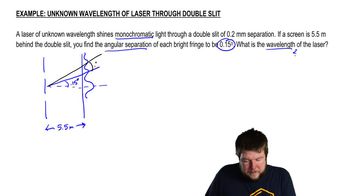
Unknown Wavelength of Laser through Double Slit

Kinetic Energy and Potential Difference

When an electron is accelerated through a potential difference (V), it gains kinetic energy equal to the work done on it by the electric field. This relationship is expressed as KE = eV, where KE is the kinetic energy, e is the charge of the electron, and V is the potential difference. This principle is crucial for determining the energy required to achieve a specific velocity, which in turn affects the de Broglie wavelength.
Recommended video:
Guided course
07:24
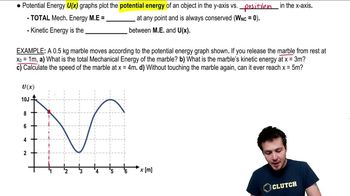
Potential Energy Graphs

Momentum of an Electron

The momentum of an electron is defined as the product of its mass and velocity (p = mv). In the context of quantum mechanics, the momentum is also related to the de Broglie wavelength. As the electron is accelerated, its velocity increases, leading to a change in momentum, which directly influences the wavelength according to the de Broglie relation.
Recommended video:
Guided course
05:17
Intro to Momentum