
Consider an oil droplet of mass m and charge q. We want to determine the charge on the droplet in a Millikan-type experiment. We will do this in several steps. Assume, for simplicity, that the charge is positive and that the electric field between the plates points upward. An electric field is established by applying a potential difference to the plates. It is found that a field of strength E₀ will cause the droplet to be suspended motionless. Write an expression for the droplet's charge in terms of the suspending field E₀ and the droplet's weight mg.
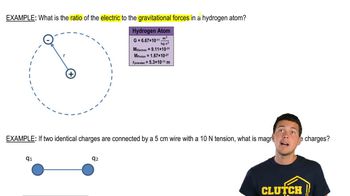
Physicists first attempted to understand the hydrogen atom by applying the laws of classical physics. Consider an electron of mass m and charge −e in a circular orbit of radius r around a proton of charge +e. Use Newtonian physics to show that the total energy of the atom is E =−e²/8πϵ₀𝓇
Verified step by step guidance
Verified video answer for a similar problem:
Key Concepts
Coulomb's Law
Kinetic Energy
Potential Energy in Electrostatics
Physicists first attempted to understand the hydrogen atom by applying the laws of classical physics. Consider an electron of mass m and charge −e in a circular orbit of radius r around a proton of charge +e. The minimum energy needed to ionize a hydrogen atom (i.e., to remove the electron) is found experimentally to be 13.6 eV. From this information, what are the electron's speed and the radius of its orbit?
A classical atom that has an electron orbiting at frequency ⨍ would emit electromagnetic waves of frequency ⨍ because the electron's orbit, seen edge-on, looks like an oscillating electric dipole. What is the total mechanical energy of this atom?
Consider an oil droplet of mass m and charge q. We want to determine the charge on the droplet in a Millikan-type experiment. We will do this in several steps. Assume, for simplicity, that the charge is positive and that the electric field between the plates points upward. A spherical object of radius r moving slowly through the air is known to experience a retarding force Fdrag = −6πηrv where η is the viscosity of the air. Use this and your answer to part b to show that a spherical droplet of density ρ falling with a terminal velocity vterm has a radius.
The oxygen nucleus ¹⁶O has a radius of 3.0 fm. With what speed must a proton be fired toward an oxygen nucleus to have a turning point 1.0 fm from the surface? Assume the nucleus remains at rest.
To initiate a nuclear reaction, an experimental nuclear physicist wants to shoot a proton into a 5.50-fm-diameter ¹²C nucleus. The proton must impact the nucleus with a kinetic energy of 3.00 MeV. Assume the nucleus remains at rest. Through what potential difference must the proton be accelerated from rest to acquire this speed?
