
Ch 37: The Foundations of Modern Physics
Knight Calc - Physics for Scientists and Engineers 5th Edition
Knight Calc5th EditionPhysics for Scientists and EngineersISBN: 9780137344796Not the one you use?Change textbook
Chapter 37, Problem 49a

Consider an oil droplet of mass m and charge q. We want to determine the charge on the droplet in a Millikan-type experiment. We will do this in several steps. Assume, for simplicity, that the charge is positive and that the electric field between the plates points upward. An electric field is established by applying a potential difference to the plates. It is found that a field of strength E₀ will cause the droplet to be suspended motionless. Write an expression for the droplet's charge in terms of the suspending field E₀ and the droplet's weight mg.

Verified step by step guidance
1
Step 1: Begin by identifying the forces acting on the oil droplet. Since the droplet is motionless, the net force acting on it must be zero. The two forces at play are the gravitational force (weight) acting downward, given by \( F_g = mg \), and the electric force acting upward, given by \( F_e = qE_0 \).
Step 2: Apply the condition for equilibrium. Since the droplet is suspended motionless, the upward electric force must exactly balance the downward gravitational force. Mathematically, this can be expressed as \( F_e = F_g \), or \( qE_0 = mg \).
Step 3: Solve for the charge \( q \) on the droplet. Rearrange the equation \( qE_0 = mg \) to isolate \( q \). This gives \( q = \frac{mg}{E_0} \).
Step 4: Interpret the result. The charge \( q \) on the droplet is directly proportional to its weight \( mg \) and inversely proportional to the strength of the electric field \( E_0 \). This means that a stronger electric field would require less charge to balance the droplet's weight.
Step 5: Conclude by noting that this expression \( q = \frac{mg}{E_0} \) provides a way to calculate the charge on the droplet if the mass \( m \), gravitational acceleration \( g \), and electric field strength \( E_0 \) are known.

Verified video answer for a similar problem:

This video solution was recommended by our tutors as helpful for the problem above.
Was this helpful?

Key Concepts

Here are the essential concepts you must grasp in order to answer the question correctly.

Electric Field

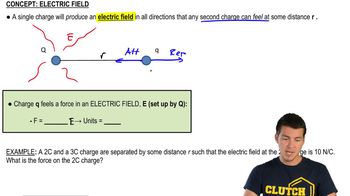
An electric field is a region around a charged object where other charged objects experience a force. It is defined as the force per unit charge and is represented by the symbol E. In the context of the Millikan experiment, the electric field is created between two plates by applying a potential difference, allowing charged droplets to be manipulated and suspended against gravitational forces.
Recommended video:
Guided course
03:16
Intro to Electric Fields

Weight of an Object

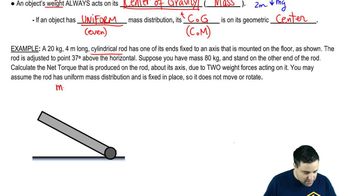
The weight of an object is the force exerted on it due to gravity, calculated as the product of its mass (m) and the acceleration due to gravity (g). In this scenario, the weight acts downward on the oil droplet, counteracting the upward force exerted by the electric field. Understanding the balance between these forces is crucial for determining the charge on the droplet.
Recommended video:
Guided course
10:19
Torque Due to Weight

Force Balance in Millikan Experiment

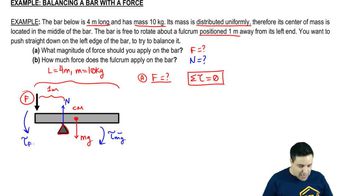
In a Millikan-type experiment, the charge on a droplet can be determined by analyzing the forces acting on it. When the droplet is suspended motionless, the upward electric force (qE₀) equals the downward gravitational force (mg). This balance allows us to derive the expression for the droplet's charge (q) in terms of the electric field strength (E₀) and the droplet's weight (mg), leading to the equation q = mg/E₀.
Recommended video:
Guided course
06:05
Balancing a bar with a force
Related Practice
Textbook Question

Physicists first attempted to understand the hydrogen atom by applying the laws of classical physics. Consider an electron of mass m and charge −e in a circular orbit of radius r around a proton of charge +e. The minimum energy needed to ionize a hydrogen atom (i.e., to remove the electron) is found experimentally to be 13.6 eV. From this information, what are the electron's speed and the radius of its orbit?

1
views
Textbook Question

A classical atom that has an electron orbiting at frequency ⨍ would emit electromagnetic waves of frequency ⨍ because the electron's orbit, seen edge-on, looks like an oscillating electric dipole. What is the total mechanical energy of this atom?

1
views
Textbook Question

Consider an oil droplet of mass m and charge q. We want to determine the charge on the droplet in a Millikan-type experiment. We will do this in several steps. Assume, for simplicity, that the charge is positive and that the electric field between the plates points upward. A spherical object of radius r moving slowly through the air is known to experience a retarding force Fdrag = −6πηrv where η is the viscosity of the air. Use this and your answer to part b to show that a spherical droplet of density ρ falling with a terminal velocity vterm has a radius. r=9ηvterm2ρgr = \(\sqrt{\frac{9\eta v_{term}\)}{2\(\rho\) g}}

Textbook Question

Physicists first attempted to understand the hydrogen atom by applying the laws of classical physics. Consider an electron of mass m and charge −e in a circular orbit of radius r around a proton of charge +e. Use Newtonian physics to show that the total energy of the atom is E =−e²/8πϵ₀𝓇

1
views