Ch 36: Special Relativity
Knight Calc - Physics for Scientists and Engineers 5th Edition
Knight Calc5th EditionPhysics for Scientists and EngineersISBN: 9780137344796Not the one you use?Change textbook
Chapter 36, Problem 3

A newspaper delivery boy is riding his bicycle down the street at 5.0 m/s. He can throw a paper at a speed of 8.0 m/s. What is the paper's speed relative to the ground if he throws the paper (a) forward, (b) backward, and (c) to the side?

Verified step by step guidance
1
Step 1: Understand the problem. The problem involves relative velocity, which is the velocity of one object as observed from another. The delivery boy's velocity relative to the ground is 5.0 m/s, and the paper's velocity relative to the boy is 8.0 m/s. We need to calculate the paper's velocity relative to the ground in three different directions: forward, backward, and to the side.
Step 2: Use the concept of vector addition for relative velocity. The velocity of the paper relative to the ground (v_pg) can be expressed as the sum of the velocity of the paper relative to the boy (v_pb) and the velocity of the boy relative to the ground (v_bg). Mathematically: vpg = vpb + vbg .
Step 3: (a) For the forward throw, the paper's velocity relative to the boy is in the same direction as the boy's motion. Add the magnitudes of the velocities: vpg = 8.0 + 5.0 m/s.
Step 4: (b) For the backward throw, the paper's velocity relative to the boy is in the opposite direction to the boy's motion. Subtract the magnitudes of the velocities: vpg = 5.0 - 8.0 m/s. Note that the result may be negative, indicating the paper moves in the opposite direction to the boy's motion.
Step 5: (c) For the side throw, the paper's velocity relative to the boy is perpendicular to the boy's motion. Use the Pythagorean theorem to find the resultant velocity: vpg = vbg^2 + vpb^2 .

Verified video answer for a similar problem:

This video solution was recommended by our tutors as helpful for the problem above.
Was this helpful?

Key Concepts

Here are the essential concepts you must grasp in order to answer the question correctly.

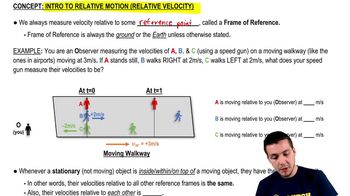
Relative Velocity

Relative velocity is the velocity of an object as observed from a particular reference frame. In this scenario, the delivery boy's speed and the speed of the paper must be combined vectorially to determine the paper's speed relative to the ground. This concept is crucial for understanding how different frames of reference affect the perceived speed of moving objects.
Recommended video:
Guided course
04:27
Intro to Relative Motion (Relative Velocity)

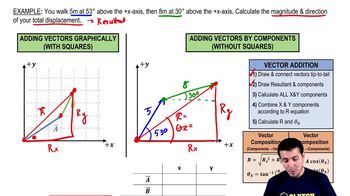
Vector Addition

Vector addition is the process of combining two or more vectors to determine a resultant vector. In this case, the velocities of the bicycle and the paper must be added or subtracted based on their directions. Understanding how to perform vector addition is essential for accurately calculating the paper's speed in different scenarios.
Recommended video:
Guided course
07:30
Vector Addition By Components

Direction of Motion

The direction of motion refers to the orientation in which an object is moving. In this problem, the paper can be thrown in three different directions: forward, backward, and to the side. Recognizing how these directions interact with the bicycle's velocity is key to determining the resultant speed of the paper relative to the ground.
Recommended video: