
Ch 36: Special Relativity
Knight Calc - Physics for Scientists and Engineers 5th Edition
Knight Calc5th EditionPhysics for Scientists and EngineersISBN: 9780137344796Not the one you use?Change textbook
Chapter 36, Problem 4

A baseball pitcher can throw a ball with a speed of 40 m/s. He is in the back of a pickup truck that is driving away from you. He throws the ball in your direction, and it floats toward you at a lazy 10 m/s. What is the speed of the truck?

Verified step by step guidance
1
Step 1: Identify the reference frames. The problem involves two reference frames: the stationary observer (you) and the moving truck. The speed of the ball relative to the truck is given as 40 m/s, and the speed of the ball relative to you is given as 10 m/s.
Step 2: Use the concept of relative velocity. The relative velocity equation is: \( v_{ball/observer} = v_{ball/truck} - v_{truck/observer} \), where \( v_{ball/observer} \) is the velocity of the ball relative to the observer, \( v_{ball/truck} \) is the velocity of the ball relative to the truck, and \( v_{truck/observer} \) is the velocity of the truck relative to the observer.
Step 3: Substitute the known values into the equation. From the problem, \( v_{ball/observer} = 10 \ \text{m/s} \) and \( v_{ball/truck} = 40 \ \text{m/s} \). The equation becomes: \( 10 = 40 - v_{truck/observer} \).
Step 4: Solve for \( v_{truck/observer} \). Rearrange the equation to isolate \( v_{truck/observer} \): \( v_{truck/observer} = 40 - 10 \).
Step 5: Conclude the calculation. The speed of the truck relative to the observer is the result of the subtraction in Step 4. This gives the final answer for the truck's speed.

Verified video answer for a similar problem:

This video solution was recommended by our tutors as helpful for the problem above.
Was this helpful?

Key Concepts

Here are the essential concepts you must grasp in order to answer the question correctly.

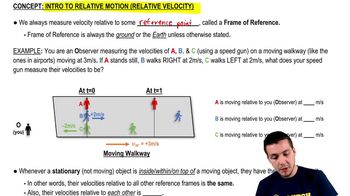
Relative Velocity

Relative velocity is the velocity of an object as observed from a particular reference frame. In this scenario, the speed of the baseball and the truck must be analyzed from the perspective of the observer. The velocities of the truck and the ball are combined to determine how fast the truck is moving away from the observer.
Recommended video:
Guided course
04:27
Intro to Relative Motion (Relative Velocity)

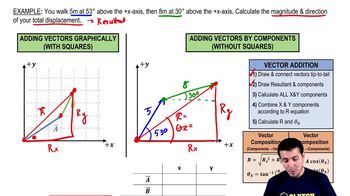
Vector Addition

Vector addition is the process of combining two or more vectors to determine a resultant vector. In this case, the velocities of the truck and the baseball must be added vectorially to find the speed of the truck. Since the ball is thrown in the direction of the observer, its velocity must be considered negative relative to the truck's forward motion.
Recommended video:
Guided course
07:30
Vector Addition By Components

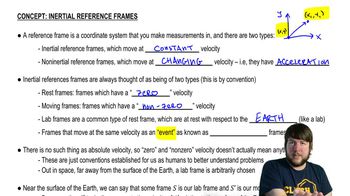
Frame of Reference

A frame of reference is a coordinate system used to measure the position and motion of objects. The observer's frame of reference is crucial in this problem, as it affects how the speeds of the truck and the baseball are perceived. Understanding the frame of reference allows for accurate calculations of relative speeds and directions.
Recommended video:
Guided course
14:10
Inertial Reference Frames