Ch 35: Optical Instruments
Knight Calc - Physics for Scientists and Engineers 5th Edition
Knight Calc5th EditionPhysics for Scientists and EngineersISBN: 9780137344796Not the one you use?Change textbook
Chapter 35, Problem 22b

A hydrogen discharge lamp emits light with two prominent wavelengths: 656 nm (red) and 486 nm (blue). The light enters a flint-glass prism perpendicular to one face and then refracts through the hypotenuse back into the air. The angle between these two faces is 35°. What is the angle (in degrees) between the red and blue light as it leaves the prism?

Verified step by step guidance
1
Step 1: Understand the problem. The goal is to calculate the angular separation between the red and blue light as they exit the prism. This involves using Snell's law and the refractive indices of flint glass for the given wavelengths.
Step 2: Use Snell's law at the first interface where the light enters the prism. Snell's law is given by: nairsinθ=nglasssinθ'. Since the light enters perpendicular to the face, the angle of incidence is 0°, and the light passes straight into the prism without refraction.
Step 3: Calculate the refraction at the hypotenuse face of the prism. The refractive indices of flint glass for red (656 nm) and blue (486 nm) light are different, which causes dispersion. Use Snell's law again: nglasssinθ'=nairsinθ'', where θ' is the angle inside the prism and θ'' is the angle of refraction as the light exits.
Step 4: Determine the angular separation. The refractive indices for red and blue light will result in slightly different refraction angles θ''. Subtract the refraction angle for red light from the refraction angle for blue light to find the angular separation.
Step 5: Use the geometry of the prism. The angle between the two faces of the prism (35°) affects the internal angles. Combine this with the calculated refraction angles to determine the final angular separation between the red and blue light as they exit the prism.

Verified video answer for a similar problem:

This video solution was recommended by our tutors as helpful for the problem above.
Video duration:
8m
Was this helpful?

Key Concepts

Here are the essential concepts you must grasp in order to answer the question correctly.

Refraction

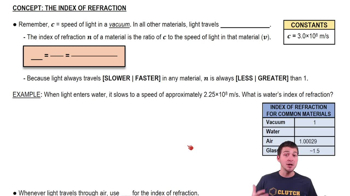
Refraction is the bending of light as it passes from one medium to another with a different density, which changes its speed. This phenomenon is governed by Snell's Law, which relates the angles of incidence and refraction to the indices of refraction of the two media. In this case, light entering the flint-glass prism will bend at the interface between air and glass, and again when it exits back into the air.
Recommended video:
Guided course
03:46
Index of Refraction

Wavelength and Color

The wavelength of light determines its color, with shorter wavelengths corresponding to blue light and longer wavelengths corresponding to red light. In this scenario, the hydrogen discharge lamp emits light at two specific wavelengths: 656 nm for red and 486 nm for blue. The difference in wavelengths affects how each color refracts through the prism, leading to a separation of the colors as they exit.
Recommended video:
Guided course
05:42
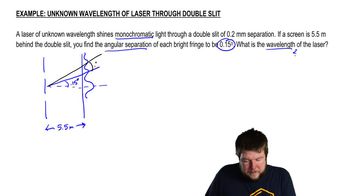
Unknown Wavelength of Laser through Double Slit

Angle of Deviation

The angle of deviation is the angle between the original path of light and its path after refraction. When light exits the prism, the angle of deviation can be calculated for each wavelength, which will differ due to their distinct refractive indices in the glass. The difference in these angles of deviation for the red and blue light will give the angle between the two colors as they leave the prism.
Recommended video:
Guided course
01:04
Critical Angle