Ch 35: Optical Instruments
Knight Calc - Physics for Scientists and Engineers 5th Edition
Knight Calc5th EditionPhysics for Scientists and EngineersISBN: 9780137344796Not the one you use?Change textbook
Chapter 35, Problem 28b

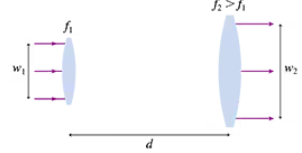
A common optical instrument in a laser laboratory is a beam expander. One type of beam expander is shown in FIGURE P35.28. The parallel rays of a laser beam of width w₁ enter from the left. What is the width w2 of the exiting laser beam?

Verified step by step guidance
1
Identify the optical components in the beam expander. Typically, a beam expander consists of two lenses: a converging lens (with focal length f₁) and a diverging lens (with focal length f₂). The lenses are separated by the sum of their focal lengths (f₁ + f₂).
Understand the relationship between the beam widths and the focal lengths of the lenses. The magnification (M) of the beam expander is given by the ratio of the focal lengths of the two lenses: M = |f₂ / f₁|.
Relate the magnification to the beam widths. The width of the exiting laser beam (w₂) is related to the width of the entering laser beam (w₁) by the magnification: w₂ = M × w₁. Substituting the magnification, this becomes w₂ = |f₂ / f₁| × w₁.
Substitute the known values of w₁, f₁, and f₂ into the equation w₂ = |f₂ / f₁| × w₁ to calculate the width of the exiting laser beam.
Verify the units and ensure that the focal lengths and beam widths are in consistent units (e.g., meters or millimeters) before performing the calculation.

Verified video answer for a similar problem:

This video solution was recommended by our tutors as helpful for the problem above.
Was this helpful?

Key Concepts

Here are the essential concepts you must grasp in order to answer the question correctly.

Beam Expansion

Beam expansion refers to the process of increasing the diameter of a laser beam as it passes through an optical system, such as a beam expander. This is typically achieved using a combination of lenses that manipulate the light's path, allowing for a wider output beam, which can be beneficial for various applications in optics and laser technology.
Recommended video:
Guided course
13:40
Beam supporting an object

Lens Formula

The lens formula relates the object distance, image distance, and focal length of a lens. It is expressed as 1/f = 1/d_o + 1/d_i, where f is the focal length, d_o is the object distance, and d_i is the image distance. Understanding this formula is crucial for calculating how light converges or diverges through lenses in a beam expander.
Recommended video:
05:38
Lens Maker Equation

Magnification

Magnification in optics describes how much larger an image is compared to the object size. For beam expanders, magnification can be calculated as the ratio of the output beam width to the input beam width. This concept is essential for determining the width of the exiting laser beam (w₂) based on the initial width (w₁) and the characteristics of the optical system.
Recommended video:
09:03
Mirror Equation
Related Practice
Textbook Question

A scientist needs to focus a helium-neon laser beam (⋋ = 633 nm) to a 10-μm-diameter spot 8.0 cm behind a lens. What minimum diameter must the lens have?

1
views

Textbook Question

The cornea, a boundary between the air and the aqueous humor, has a 3.0 cm focal length when acting alone. What is its radius of curvature?

2
views
Textbook Question

A 1.0-cm-tall object is 110 cm from a screen. A diverging lens with focal length -20 cm is 20 cm in front of the object. What are the focal length and distance from the screen of a second lens that will produce a well-focused, 2.0-cm-tall on the screen?

1
views
Textbook Question

A 15-cm-focal-length converging lens is 20 cm to the right of a 7.0-cm-focal-length converging lens. A 1.0-cm-tall object is distance L to the left of the 7.0-cm-focal-length lens. What are the height and orientation of the final image?

2
views
Textbook Question

A hydrogen discharge lamp emits light with two prominent wavelengths: 656 nm (red) and 486 nm (blue). The light enters a flint-glass prism perpendicular to one face and then refracts through the hypotenuse back into the air. The angle between these two faces is 35°. What is the angle (in degrees) between the red and blue light as it leaves the prism?

2
views
Textbook Question

Infrared telescopes, which use special infrared detectors, are able to peer farther into star-forming regions of the galaxy because infrared light is not scattered as strongly as is visible light by the tenuous clouds of hydrogen gas from which new stars are created. For what wavelength of light is the scattering only 1% that of light with a visible wavelength of 500 nm?

1
views