Ch 32: AC Circuits
Knight Calc - Physics for Scientists and Engineers 5th Edition
Knight Calc5th EditionPhysics for Scientists and EngineersISBN: 9780137344796Not the one you use?Change textbook
Chapter 32, Problem 27a

A series RLC circuit has a 200 kHz resonance frequency. What is the resonance frequency if the resistor value is doubled?

Verified step by step guidance
1
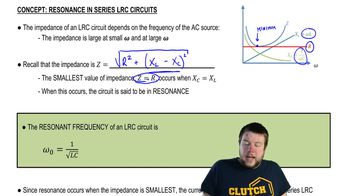
Understand the concept of resonance frequency in an RLC circuit: The resonance frequency \( f_0 \) of a series RLC circuit is determined by the inductance \( L \) and capacitance \( C \), and is given by the formula \( f_0 = \frac{1}{2\pi\sqrt{LC}} \). Note that the resistance \( R \) does not affect the resonance frequency directly.
Recognize that doubling the resistor value does not change the inductance \( L \) or capacitance \( C \). The resonance frequency depends only on \( L \) and \( C \), so the formula remains unchanged.
Conclude that the resonance frequency \( f_0 \) will remain the same, regardless of the change in the resistor value. The resonance frequency is still \( 200 \ \text{kHz} \).
If needed, verify this by substituting values into the resonance frequency formula \( f_0 = \frac{1}{2\pi\sqrt{LC}} \) and observing that \( R \) does not appear in the equation.
Summarize: Doubling the resistor value does not affect the resonance frequency of the circuit, which remains at \( 200 \ \text{kHz} \).

Verified video answer for a similar problem:

This video solution was recommended by our tutors as helpful for the problem above.
Was this helpful?

Key Concepts

Here are the essential concepts you must grasp in order to answer the question correctly.

Resonance Frequency in RLC Circuits

The resonance frequency of an RLC circuit is the frequency at which the circuit naturally oscillates due to the inductance (L) and capacitance (C) in the circuit. It is given by the formula f₀ = 1 / (2π√(LC)). At this frequency, the impedance of the circuit is minimized, and the circuit can store and transfer energy between the inductor and capacitor efficiently.
Recommended video:
Guided course
05:23
Resonance in Series LRC Circuits

Effect of Resistance on Resonance

In an RLC circuit, the resistance (R) affects the damping of the oscillations but does not change the resonance frequency itself. Doubling the resistance will increase the damping factor, leading to a decrease in the amplitude of oscillations at resonance, but the resonance frequency remains determined solely by the values of L and C.
Recommended video:
Guided course
05:23
Resonance in Series LRC Circuits

Damping in RLC Circuits

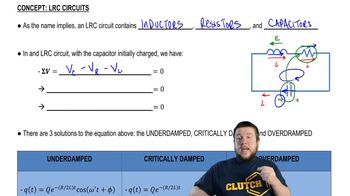
Damping refers to the effect of resistance in an RLC circuit, which causes the oscillations to decrease over time. In a damped RLC circuit, the presence of resistance leads to energy loss, affecting the quality factor (Q) of the circuit. While the resonance frequency remains constant, higher resistance results in a lower Q factor, indicating less sharpness in the resonance peak.
Recommended video: