
Ch 28: Fundamentals of Circuits
Knight Calc - Physics for Scientists and Engineers 5th Edition
Knight Calc5th EditionPhysics for Scientists and EngineersISBN: 9780137344796Not the one you use?Change textbook
Chapter 28, Problem 68

A circuit you’re using discharges a 20 μF capacitor through an unknown resistor. After charging the capacitor, you close a switch at t = 0 s and then monitor the resistor current with an ammeter. Your data are as follows: Use an appropriate graph of the data to determine (a) the resistance and (b) the initial capacitor voltage.

Verified step by step guidance
1
Step 1: Understand the problem. The capacitor discharges through a resistor, and the current decreases over time. This is a classic RC (resistor-capacitor) circuit problem. The current follows an exponential decay described by the equation: I=I0e-t/τ, where τ=RC is the time constant.
Step 2: Plot the data. Use the given current values and corresponding time values to create a graph. Plot the natural logarithm of the current (ln(I)) versus time (t). This will linearize the exponential decay equation, as ln(I)=ln(I0)-t/τ.
Step 3: Determine the slope of the linear graph. The slope of the graph (-1/τ) is related to the time constant τ. Use the slope to calculate the resistance R, knowing the capacitance C=20μF. Rearrange the formula τ=RC to solve for R: R=τ/C.
Step 4: Determine the initial capacitor voltage. The initial current I0 can be found from the y-intercept of the graph (ln(I0)). Use Ohm's law V0=I0R to calculate the initial voltage across the capacitor.
Step 5: Verify your results. Ensure the calculated resistance and initial voltage are consistent with the data and the physical behavior of the RC circuit. Double-check the graph and calculations for accuracy.

Verified video answer for a similar problem:

This video solution was recommended by our tutors as helpful for the problem above.
Was this helpful?

Key Concepts

Here are the essential concepts you must grasp in order to answer the question correctly.

Capacitance

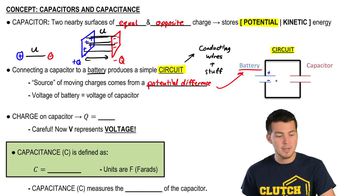
Capacitance is the ability of a capacitor to store electrical charge, measured in farads (F). A 20 μF capacitor can store a charge proportional to the voltage across it, following the relationship Q = C * V, where Q is charge, C is capacitance, and V is voltage. Understanding capacitance is crucial for analyzing how the capacitor discharges through the resistor over time.
Recommended video:
Guided course
08:02
Capacitors & Capacitance (Intro)

Ohm's Law

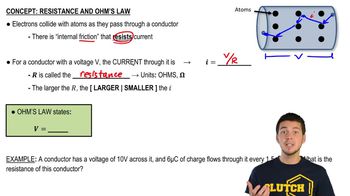
Ohm's Law states that the current (I) flowing through a conductor between two points is directly proportional to the voltage (V) across the two points and inversely proportional to the resistance (R) of the conductor, expressed as V = I * R. This fundamental principle is essential for determining the resistance in the circuit by analyzing the current and voltage data collected during the capacitor's discharge.
Recommended video:
Guided course
03:07
Resistance and Ohm's Law

Exponential Decay in RC Circuits

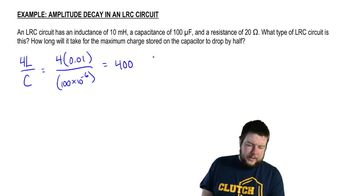
In an RC (resistor-capacitor) circuit, the voltage across the capacitor and the current through the resistor decrease exponentially over time after the switch is closed. The voltage can be described by the equation V(t) = V0 * e^(-t/RC), where V0 is the initial voltage, R is resistance, and C is capacitance. This behavior is key to graphing the data and extracting both the resistance and the initial voltage of the capacitor.
Recommended video:
Guided course
04:24
Amplitude Decay in an LRC Circuit