
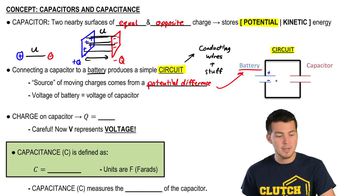
The capacitor in an RC circuit is discharged with a time constant of 10 ms. At what time after the discharge begins are (a) the charge on the capacitor reduced to half its initial value and (b) the energy stored in the capacitor reduced to half its initial value?
A 15 μF capacitor charged to 12 V is discharged through a resistor. The energy stored in the capacitor decreases by 50% in 0.25 s. What is the value of the resistance?
Verified step by step guidance
Verified video answer for a similar problem:
Key Concepts
Capacitance
Energy Stored in a Capacitor
RC Time Constant
You’ve made the finals of the Science Olympics! As one of your tasks, you’re given 1.0 g of aluminum and asked to make a wire, using all the aluminum, that will dissipate 7.5 W when connected to a 1.5 V battery. What length and diameter will you choose for your wire?
The capacitor in FIGURE P28.73 begins to charge after the switch closes at t = 0 s. Find an expression for the current I at time t. Graph I from t = 0 to t = 5τ.
The flash on a compact camera stores energy in a 120 μF capacitor that is charged to 220 V. When the flash is fired, the capacitor is quickly discharged through a lightbulb with 5.0 Ω of resistance. At what rate is the lightbulb dissipating energy 250 μs after the flash is fired?
A 150 μF defibrillator capacitor is charged to 1500 V. When fired through a patient’s chest, it loses 95% of its charge in 40 ms. What is the resistance of the patient’s chest?
A circuit you’re using discharges a 20 μF capacitor through an unknown resistor. After charging the capacitor, you close a switch at t = 0 s and then monitor the resistor current with an ammeter. Your data are as follows: Use an appropriate graph of the data to determine (a) the resistance and (b) the initial capacitor voltage.
