Ch 28: Fundamentals of Circuits
Knight Calc - Physics for Scientists and Engineers 5th Edition
Knight Calc5th EditionPhysics for Scientists and EngineersISBN: 9780137344796Not the one you use?Change textbook
Chapter 28, Problem 56b

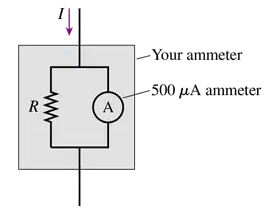
A circuit you're building needs an ammeter that goes from 0 mA to a full-scale reading of 50 mA. Unfortunately, the only ammeter in the storeroom goes from 0 μA to a full-scale reading of only 500 μA. Fortunately, you've just finished a physics class, and you realize that you can make this ammeter work by putting a resistor in parallel with it, as shown in FIGURE P28.56. You've measured that the resistance of the ammeter is 50.0 Ω, not the 0 Ω of an ideal ammeter. What is the effective resistance of your ammeter?
Schematic showing a circuit with a 500 μA ammeter and a resistor labeled "R" in parallel, indicating current flow.

Verified step by step guidance
1
Step 1: Understand the problem. The goal is to calculate the effective resistance of the modified ammeter circuit, which consists of the original ammeter (with resistance 50.0 Ω) in parallel with an additional resistor R. The effective resistance of the parallel combination will allow the ammeter to handle a full-scale current of 50 mA.
Step 2: Recall the formula for the equivalent resistance of two resistors in parallel. The formula is: Reff=11Rammeter+1R, where Rammeter is the resistance of the ammeter (50.0 Ω) and R is the resistance of the parallel resistor.
Step 3: Determine the current through the ammeter and the parallel resistor. The original ammeter can handle a maximum current of 500 μA, while the modified circuit needs to handle a full-scale current of 50 mA. The parallel resistor R must carry the remaining current, which is 500.5=49.5 mA.
Step 4: Use Ohm's Law to relate the voltage across the ammeter and the parallel resistor. The voltage across both components is the same because they are in parallel. Using Ohm's Law, V=IR, calculate the resistance R required to carry 49.5 mA while maintaining the same voltage as the ammeter.
Step 5: Substitute the values into the parallel resistance formula to find the effective resistance of the circuit. Once R is calculated, use the formula from Step 2 to compute Reff, which represents the effective resistance of the modified ammeter circuit.

Verified video answer for a similar problem:

This video solution was recommended by our tutors as helpful for the problem above.
Was this helpful?

Key Concepts

Here are the essential concepts you must grasp in order to answer the question correctly.

Ammeter Functionality

An ammeter is a device used to measure electric current in a circuit. It is connected in series with the circuit and ideally has zero resistance, allowing it to measure current without affecting the circuit. However, real ammeters have some internal resistance, which can influence the total current flowing through the circuit.
Recommended video:
Guided course
08:30
Intro to Wave Functions

Parallel Resistance

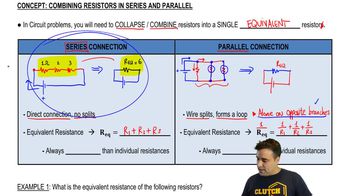
When resistors are connected in parallel, the total or effective resistance decreases. The formula for calculating the total resistance (R_total) of two resistors in parallel (R1 and R2) is given by 1/R_total = 1/R1 + 1/R2. This concept is crucial for modifying the ammeter's range by adding a resistor in parallel to achieve the desired current measurement.
Recommended video:
Guided course
12:42
Combining Resistors in Series & Parallel

Ohm's Law

Ohm's Law states that the current (I) flowing through a conductor between two points is directly proportional to the voltage (V) across the two points and inversely proportional to the resistance (R) of the conductor. It is expressed as V = I × R. Understanding this law is essential for analyzing circuits and calculating the effective resistance when modifying the ammeter's configuration.
Recommended video:
Guided course
03:07
Resistance and Ohm's Law